Motorcycle Towing: 5 Questions to Ask Before Your Bike Gets Loaded
🏍️ Quick Answer
Motorcycle towing requires a flatbed truck, proper wheel chocks, soft-loop tie-down straps at four points minimum, and an operator who has loaded bikes before. Never let anyone tow your motorcycle with a wheel-lift, dolly, or hook — the bike will fall, slide, or sustain frame damage. Before your motorcycle gets loaded, ask these five questions: Are you using a flatbed? Do you have a wheel chock? What type of straps do you use? Have you towed motorcycles before? Will the front fork be compressed during tie-down? In Hamilton, motorcycle towing typically costs $100–$200 for a local tow and requires a company experienced in safe motorcycle transport.
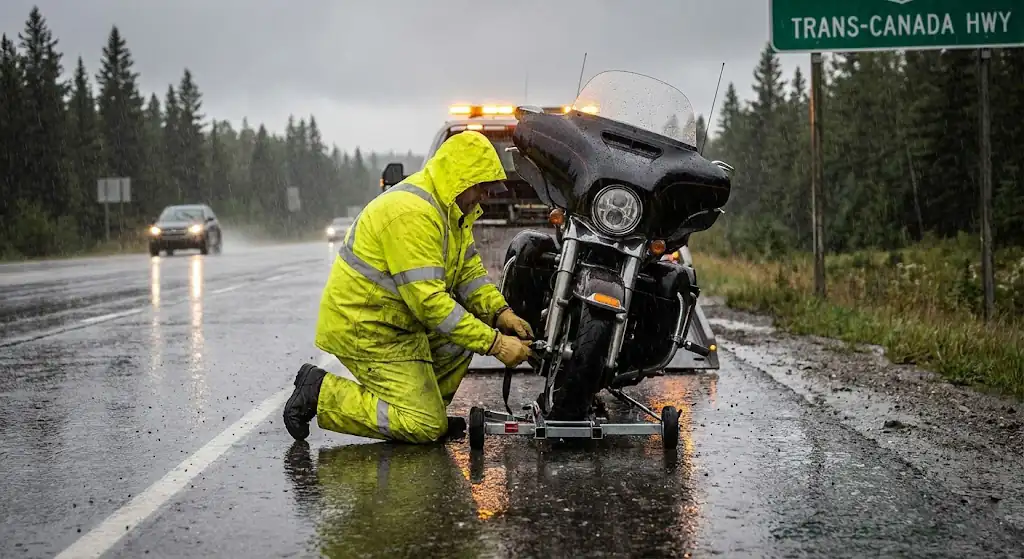
Your motorcycle isn’t a car. That statement seems obvious, but it’s the reason most towing-related motorcycle damage happens — when an operator who’s used to handling four-wheeled vehicles applies the same methods to a bike. A car can tolerate a lot during transport. A motorcycle cannot. One strap in the wrong place, one missing chock, one careless bump during loading — and you’re looking at bent handlebars, cracked fairings, scratched paint, or a bike that falls off the truck entirely.
Motorcycle towing is a specialized service. Not every towing company offers it, and not every company that claims to offer it does it properly. The difference between a professional motorcycle tow and an amateur one isn’t just technique — it’s hundreds or thousands of dollars in potential damage to a machine you care deeply about.
This guide covers the five critical questions you should ask before anyone loads your bike, how safe motorcycle transport actually works, what it costs in Hamilton, and how to make sure your motorcycle arrives at its destination in the same condition it left. If your bike needs a tow right now, call Towing Hamilton’s motorcycle towing service at (905) 481-0133.
Why Motorcycle Towing Is Different from Car Towing
Before diving into the five questions, it helps to understand why motorcycles require a fundamentally different towing approach than cars:
Motorcycles don’t stand on their own. A car sits stable on four wheels. A motorcycle stays upright through balance, a kickstand, or a centre stand — none of which provide the kind of stability needed during truck transport over bumpy roads, highway speeds, and hard braking. Without proper restraints, a bike will tip over on the truck bed.
Motorcycles have exposed components. Fairings, mirrors, handlebars, exhaust pipes, tank paint, levers, and turn signals are all exposed and vulnerable. A tie-down strap placed against a painted fairing can scratch through clearcoat in minutes of vibration. A strap hooked to a mirror mount can snap the mirror clean off. Every contact point matters.
Motorcycles are lighter and move more during transport. A 200 kg motorcycle experiences significantly more relative movement during transport than a 1,800 kg car. Road vibration, wind buffeting at highway speed, and braking forces have a proportionally much larger effect on a bike — which is why four-point tie-down with proper tension is essential.
There’s no “neutral” for wheel-lift towing. A car can (sometimes) be wheel-lifted safely. A motorcycle cannot be towed by any method other than full flatbed loading. There is no hook-and-chain, wheel-lift, or dolly method that works for motorcycles. It’s flatbed or nothing.
The 5 Questions to Ask Before Your Motorcycle Gets Loaded
These five questions separate a professional motorcycle towing operation from one that’s going to damage your bike. Ask them every time — even if you’ve used the company before:
How Professional Motorcycle Towing Works: Step by Step
Here’s what a proper motorcycle towing job looks like from start to finish when done by an experienced operator:
Assessment. The operator visually inspects the motorcycle — noting the bike type (sport, cruiser, touring, adventure, standard), any pre-existing damage, and the best tie-down points for that specific model. They check whether the motorcycle can be ridden up the ramp or needs to be walked/pushed up, and whether the transmission can be put in neutral.
Ramp deployment. The flatbed tilts down and a loading ramp is positioned. For motorcycles, the ramp angle matters — too steep and the bike’s undercarriage or exhaust can scrape. An experienced operator adjusts the ramp position for each bike.
Loading. The motorcycle is carefully walked or ridden up the ramp. If the bike is non-running, it’s pushed up in neutral or carefully winched using a strap around the frame — never the handlebars, forks, or wheels. The operator maintains balance throughout the loading process.
Wheel chock. The front wheel is guided into the wheel chock, locking it in a straight-ahead position. The chock prevents any forward, backward, or lateral wheel movement.
Four-point tie-down. Four soft-loop straps are attached — two on the front (typically on the triple tree, fork tubes below the upper triple clamp, or handlebar risers) and two on the rear (frame, passenger pegs, rear subframe, or designated tie-down points). Straps are tightened evenly, compressing the front forks about 25–30% and creating equal tension on both sides so the bike stays perfectly upright.
Security check. The operator gently pushes the bike from side to side and front to back. There should be minimal movement — the bike should feel planted. If there’s excessive sway, straps are readjusted until the motorcycle is rock-solid.
Transport. The bed tilts back to level and the motorcycle is transported. The operator drives smoothly — gradual acceleration, gentle braking, and wide turns. At the destination, the process is reversed: straps are loosened evenly (never one side at a time, which can cause a tip), the chock is released, and the bike is carefully walked back down the ramp.
Common Motorcycle Towing Mistakes That Cause Damage
Most motorcycle towing damage is caused by operators who don’t specialize in bikes. Here are the most frequent mistakes — and the damage they cause:
🚩 No wheel chock. The front wheel turns during transport, the bike leans, and it falls on its side. Damage: bent handlebars, broken levers, cracked fairings, scratched tank. Cost: $200–$2,000+.
🚩 Metal hooks on ratchet straps. Bare metal hooks scratch chrome, paint, and anodized finishes. Every vibration during the drive grinds the metal deeper. Damage: paint damage, chrome pitting. Cost: $100–$1,000+ for professional refinishing.
🚩 Strapping to mirrors or turn signals. These components aren’t structural — they’re mounted to the handlebar or fairing with small bolts. Under tension, they snap off. Cost: $50–$400 per part depending on the bike.
🚩 Over-compressing forks. Cranking the front straps too tight bottoms out the forks, damaging fork seals, stanchions, and potentially the steering head bearings. Cost: $200–$800 for fork seal replacement, $500+ for bearing replacement.
🚩 Uneven strap tension. One side tighter than the other causes the bike to lean during transport. Over time — or over one hard brake application — the lean overcomes the strap resistance and the bike tips. The fall damage is usually worse than the lean itself.
🚩 Using a wheel-lift or dolly. These methods weren’t designed for two-wheeled vehicles. A motorcycle in a wheel-lift yoke will slide, scratch, and potentially fall off the truck entirely. There is no safe wheel-lift technique for motorcycles.
Every one of these mistakes is avoidable by using a company that actually specializes in motorcycle towing. The five questions in Section 2 exist specifically to screen out operators who would make these errors.
How Much Does Motorcycle Towing Cost in Hamilton?
Motorcycle towing pricing in Hamilton is similar to car towing, with a slight premium for the additional equipment and care required:
Prices are estimates for the Hamilton, Burlington, Waterdown, and Grimsby area. Use the Towing Hamilton cost estimator for a personalized quote. For a detailed breakdown of how per-km pricing works, see our guide on towing cost per kilometre in Ontario.
Bike Needs a Tow? We Know How to Handle It.
Flatbed truck • Wheel chock • Soft-loop straps • Experienced motorcycle operators.
(905) 481-0133
Towing Different Types of Motorcycles: What Changes?
Not all motorcycles are the same, and the towing approach adjusts based on the type of bike:
Sport bikes (CBR, R6, ZX, GSX-R). Low-mounted clip-on handlebars limit front tie-down options. Straps typically go around the fork tubes below the upper triple clamp or on frame sliders if equipped. Full fairings mean every strap placement must avoid painted bodywork. The low ground clearance requires careful ramp angle to avoid scraping the exhaust or belly pan.
Cruisers (Harley-Davidson, Indian, Vulcan). Heavier bikes (250–400 kg for touring models) that require more strap tension and sometimes a heavier-duty wheel chock. Wide handlebars provide good front tie-down points. Forward controls and low-slung exhaust pipes need clearance consideration during loading. Chrome is everywhere — soft-loop straps are essential.
Adventure / dual-sport bikes (GS, Tiger, Ténéré, Africa Twin). Taller bikes with longer suspension travel. Front fork compression needs to account for the extra travel — these forks need slightly more compression to stabilize. Crash bars, if equipped, provide excellent secondary tie-down points. Panniers and top boxes should ideally be removed before transport to prevent strap interference.
Touring bikes (Gold Wing, Road Glide, K 1600). The heaviest category — a fully loaded Honda Gold Wing exceeds 380 kg. These bikes require the most strap tension, the widest ramp, and the most careful balance management during loading. Saddlebags and trunk should be emptied of heavy items before transport. Wind fairings and infotainment screens are fragile and must be protected.
Scooters and small-displacement bikes. Lighter and easier to load, but the same tie-down principles apply. Scooter step-through frames offer different tie-down geometry — straps usually attach to the frame under the seat and around the steering column. The smaller wheels may not fit standard wheel chocks and may require a strap-based front wheel restraint instead.
For custom, modified, or high-value motorcycles with unique requirements, see our dedicated guide on motorcycle towing for custom and modified bikes.
Where to Attach Tie-Down Straps on a Motorcycle
Knowing where straps should go — and where they should never go — is one of the most important aspects of safe motorcycle transport:
✅ Safe Tie-Down Points
Front: Triple tree (the metal clamp that connects the forks to the frame), fork tubes below the upper triple clamp, handlebar risers (if solid-mounted), or frame sliders/crash bars if equipped.
Rear: Rear subframe rails, passenger footpeg brackets, rear frame rails, or designated tie-down loops (some manufacturers include these).
❌ Never Attach Straps Here
Mirrors — they’ll snap off under tension.
Turn signals — not structural, will break.
Exhaust pipes — heat damage to straps, and pipes can bend under sustained load.
Fairings or bodywork — plastic cracks under strap pressure.
Wheels or spokes — straps can bend spokes or damage rims.
Seat or seat bracket — not designed for sustained directional force.
When Do You Need Motorcycle Towing?
Beyond breakdowns, there are several situations where riders in Hamilton need professional bike towing:
Mechanical breakdown. The most common reason. Engine won’t start, electrical failure, clutch cable snapped, chain broke — any issue that makes the bike unrideable on the road. Call for a tow to your mechanic or dealer.
Flat tire. Unlike cars, most motorcycles don’t carry a spare. A flat on the road means a tow to a shop. Tubeless tire kits exist but are temporary fixes — a proper repair or replacement requires a shop.
Accident or crash. Even a low-speed drop can bend controls, break levers, or crack fairings enough to make the bike unsafe to ride. After any crash, have the bike towed — riding a damaged motorcycle home risks a second, more serious incident. Accident towing requires extra care with damaged bikes.
Seasonal transport. Many Hamilton riders store their bikes off-site over winter. Professional towing handles the fall drop-off to storage and the spring pickup — saving you from riding on cold, salt-covered roads or trailering it yourself.
Buying or selling a bike. Purchased a motorcycle from a private seller across the city — or across the province? Long-distance towing gets the bike to your garage safely without racking up kilometres on an unfamiliar machine you just bought.
Track day transport. Riders who trailer their bikes to Cayuga, Mosport, or Grand Bend for track days sometimes need professional transport when their own trailer isn’t available. A flatbed tow can deliver and retrieve the bike from the track.
Does Insurance Cover Motorcycle Towing in Ontario?
Coverage varies by policy, but here’s the general landscape for Ontario motorcycle owners:
Motorcycle insurance roadside add-on. Some Ontario motorcycle insurers offer roadside assistance as an optional rider, similar to auto insurance. Coverage typically includes towing to the nearest repair facility and sometimes on-scene services like flat tire assistance. Check your policy or call your insurer to confirm whether your motorcycle coverage includes towing.
CAA membership. CAA covers motorcycle towing under all membership tiers — the same towing distance limits apply as for cars (10 km for Basic, 200 km for Plus/Premier). The bike must be registered in Ontario and insured. CAA is one of the most reliable ways to ensure you have motorcycle towing coverage.
Manufacturer programs. Some motorcycle manufacturers include complimentary roadside assistance for the first few years of ownership. BMW, Harley-Davidson, Honda (through HondaCare), and others offer programs. Check your owner’s manual or dealership for details.
Reimbursement. Even without specific motorcycle towing coverage, keep the invoice — many insurance policies will reimburse reasonable towing costs when submitted with a claim, especially if the tow is related to a covered event (collision, theft recovery, etc.). For a complete breakdown of coverage options, see our guide on insurance and towing coverage in Ontario.
How to Prepare Your Motorcycle for Towing
While waiting for the tow truck, there are a few things you can do to make the process smoother and protect your bike:
Remove loose items. Tank bags, saddlebag contents, phone mounts, GPS units, and any accessories that could fall off during transport. Pocket them or put them in a backpack.
Note pre-existing damage. Take quick photos of the bike from all angles before the tow truck arrives. This documents the bike’s condition before transport — essential if you need to make a damage claim against the tow company later.
Put the transmission in neutral. If the bike can be shifted into neutral, do so — it makes loading significantly easier since the rear wheel can roll freely. If the clutch is seized or the engine is locked, let the operator know so they can plan accordingly.
Turn off the fuel petcock (if applicable). Older carbureted bikes with manual fuel petcocks should have the petcock turned to “off” to prevent fuel from leaking during transport, especially if the bike is tilted during loading.
Have your keys ready. The operator may need to unlock the steering lock or activate the ignition to shift into neutral. Keep your keys accessible.
Your Rights During a Motorcycle Tow
Everything in Ontario’s TSSEA applies to motorcycle towing just as it does to car towing. You have the right to choose the towing company, choose the destination, see the rate schedule before consenting, receive an itemized invoice, and pay by multiple methods. For the full list of your consumer protections, see our guide on your towing rights in Ontario under the TSSEA.
But as a motorcycle owner, you also have an additional practical right: you can refuse the tow if the operator doesn’t have proper motorcycle equipment. If the truck arrives without a wheel chock, without soft-loop straps, or if the operator is visibly unfamiliar with motorcycle loading — you can decline, call a different company, and wait for someone equipped to handle your bike correctly. No consent form has been signed. You owe them nothing.
If your motorcycle is damaged during towing due to improper handling, document the damage immediately with photos, note the operator’s TSSEA certificate number, and contact the towing company to file a claim against their commercial liability insurance. For guidance on the overall process of choosing a towing company you can trust, our buyer’s guide covers the full checklist.
Hamilton Riding Season: Planning Ahead for Emergencies
Hamilton’s riding season typically runs from April through October, with the most active months being May through September. According to Transport Canada collision data, motorcycle incidents in Ontario peak during the summer riding months. Under Ontario’s motorcycle licensing framework, riders are taught emergency procedures — but roadside towing is rarely covered in training. Being prepared makes all the difference:
Save a motorcycle-capable towing company’s number. Add (905) 481-0133 to your phone contacts now. When you’re on the side of Highway 8 with a dead bike at sunset, you don’t want to be Googling “motorcycle tow truck Hamilton” on a dying phone.
Check your towing coverage before riding season. Confirm whether your motorcycle insurance includes roadside assistance or whether your CAA membership covers motorcycles. Do this in March or April — not in June when you’re already stranded.
Carry a phone charger. A USB or battery pack that fits in your jacket pocket or under the seat can be the difference between calling for help and being truly stranded.
Know the popular Hamilton riding routes. The Niagara Escarpment roads (Highway 52, Sulphur Springs Road, Snake Road), the lakeside routes through Burlington and Grimsby, and the rural roads around Waterdown and Flamborough are popular — but some are remote. Break down on Snake Road and you’re a long way from a quick rescue. Know where you’re riding and how accessible help is.
For more on preparing for any roadside emergency, see our guide on what roadside assistance actually includes — including how CAA and insurance coverage works for motorcycles as well as cars.
Motorcycle Towing FAQ
How do you tow a motorcycle?
A motorcycle is towed on a flatbed tow truck. The bike is walked or winched up a loading ramp, the front wheel is locked into a wheel chock, and four soft-loop tie-down straps are attached — two at the front (triple tree or fork tubes) and two at the rear (frame or footpeg brackets). The front forks are compressed about 25–30% for stability. The bike rides entirely on the truck bed with all weight off its own wheels.
Can a motorcycle be towed with a wheel-lift truck?
No. A wheel-lift truck cannot safely transport a motorcycle. The yoke is designed for four-wheeled vehicles and cannot secure a two-wheeled vehicle. A motorcycle in a wheel-lift yoke will slide, lean, and very likely fall off the truck, causing significant damage. Flatbed is the only safe tow truck type for motorcycles — no exceptions.
How much does motorcycle towing cost in Hamilton?
Local motorcycle towing in Hamilton typically costs $100–$200 during daytime hours. After-hours and weekend tows run $125–$250. Long-distance motorcycle tows are priced at $3.50–$5.50 per km after the initial base rate. These prices include a flatbed truck with wheel chock and proper soft-loop tie-down straps. Get a personalized estimate at the Towing Hamilton cost estimator.
What equipment does a tow truck need to transport a motorcycle?
A proper motorcycle tow requires a flatbed tow truck, a wheel chock (metal or heavy-duty plastic cradle that locks the front wheel), at least four soft-loop tie-down straps (fabric loops that won’t scratch metal or paint), and a loading ramp with appropriate angle for motorcycle clearance. The operator should also have experience loading and securing motorcycles specifically — the technique is different from car loading.
Does CAA cover motorcycle towing?
Yes. CAA covers motorcycle towing under all membership tiers with the same distance limits as car towing — 10 km for Basic, 200 km for Plus and Premier. The motorcycle must be registered and insured in Ontario. When calling CAA for a motorcycle tow, specify that you need a flatbed with motorcycle-specific equipment to ensure the right truck is dispatched.
What if the tow truck damages my motorcycle?
Document the damage immediately with photos and note the operator’s name and TSSEA certificate number. Contact the towing company and request a claim against their commercial liability insurance. A TSSEA-certified operator is required to carry proper insurance. If they refuse to cooperate, file a complaint with the Ontario Ministry of Transportation. Having pre-tow photos of your bike’s condition strengthens your case significantly.
Can I refuse a tow truck that doesn’t have motorcycle equipment?
Absolutely. If a truck arrives without a wheel chock, without soft-loop straps, or if the operator seems unfamiliar with motorcycle loading, you have every right to refuse the service and call a different company. Under the TSSEA, no tow can proceed without your signed consent — and you are under no obligation to consent if the equipment or operator is inadequate. Never let convenience pressure you into accepting a substandard tow for your motorcycle.
Should I ride my motorcycle home after a minor accident?
It’s generally not recommended. Even a low-speed drop or minor collision can cause hidden damage — bent handlebars that look straight but pull to one side, a slightly bent fork tube that affects steering geometry, a cracked frame rail that isn’t visible, or brake damage that isn’t apparent until you need to stop hard. A tow to a mechanic for inspection is far safer than riding a bike with potentially compromised handling or brakes.
Where should tie-down straps attach on a motorcycle?
Front straps should attach to the triple tree, fork tubes below the upper triple clamp, handlebar risers, or frame sliders. Rear straps should attach to the rear subframe, passenger footpeg brackets, or designated tie-down loops. Never attach straps to mirrors, turn signals, exhaust pipes, fairings, wheels, or the seat. All straps should be soft-loop (fabric) type to prevent scratching metal and paint surfaces.
Can two motorcycles be towed on one flatbed?
Yes, depending on the flatbed size and the bikes. A standard flatbed can typically accommodate two average-size motorcycles side by side, each with its own wheel chock and four-point tie-down. This is sometimes arranged for riding groups where two bikes need towing simultaneously, or for seasonal transport of multiple bikes. Discuss this with the operator when calling — they’ll confirm whether their truck can accommodate multiple bikes.
Your Bike Deserves Better Than a Generic Tow.
Flatbed • Wheel chock • Soft-loop straps • Experienced motorcycle operators.
Hamilton, Burlington, Waterdown & Grimsby — 24/7.
(905) 481-0133