Flatbed vs. Wheel-Lift Towing: Which One Does Your Car Need?
🚛 Quick Answer
Flatbed towing loads your entire vehicle onto a flat platform — all four wheels off the ground. Wheel-lift towing lifts the front or rear wheels while the other pair rolls on the road. Use a flatbed if you have an AWD/4WD vehicle, luxury car, EV, lowered vehicle, or any car with accident damage. A wheel-lift is fine for most standard front-wheel-drive cars on short local tows with no damage. In Hamilton, wheel-lift towing costs $85–$175 locally and flatbed towing costs $100–$200. When in doubt, always choose the flatbed — the $15–$25 difference is cheap insurance against transmission damage that costs thousands.
When you call for a tow, you’re usually not thinking about how your vehicle gets transported — you just want it moved. But the type of tow truck that shows up matters more than most drivers realize. The wrong truck can cause transmission damage, scratch your paint, bend suspension components, or void your manufacturer warranty.
There are two primary types of tow trucks used for passenger vehicles: flatbed tow trucks (also called rollback or car-carrier trucks) and wheel-lift tow trucks (the modern replacement for the old hook-and-chain method). Each has specific strengths, limitations, and ideal use cases — and choosing the right one depends on your vehicle type, the situation, and the distance of the tow.
This guide breaks down the differences between flatbed towing and wheel-lift towing so you can make the right call for your car — whether you’re dealing with a breakdown, an accident, or simply need your vehicle moved. If you’re in Hamilton and need a tow right now, call Towing Hamilton’s flatbed service at (905) 481-0133 — we’ll match the right truck to your vehicle.
How Flatbed Towing Works
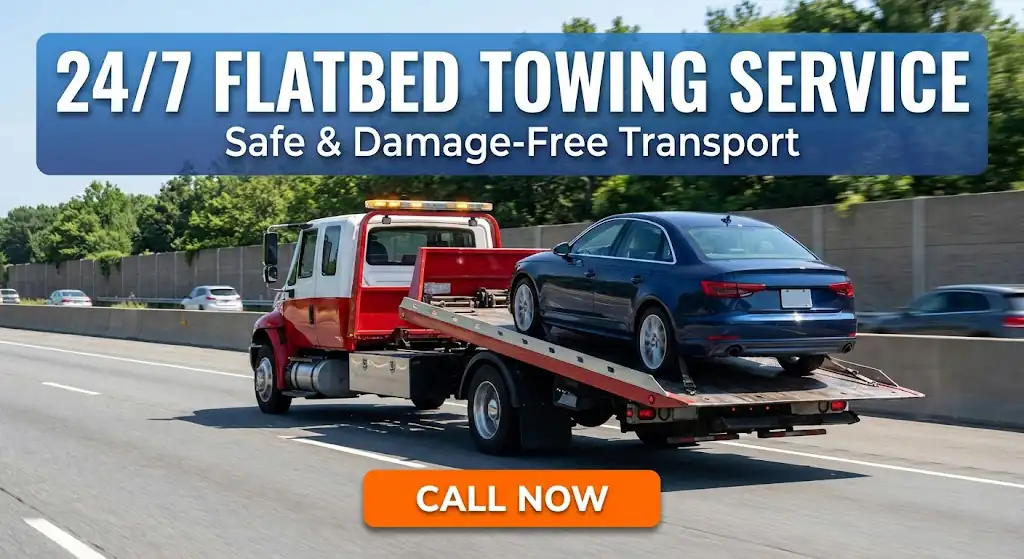
A flatbed tow truck — also called a rollback, slide, or car-carrier — has a long, flat platform on the back that tilts down to the ground at an angle. Your vehicle is driven or winched up onto the platform, then the bed tilts back to level. Once loaded, your vehicle sits completely on the truck with all four wheels off the road.
How Wheel-Lift Towing Works
A wheel-lift tow truck uses a hydraulic metal yoke (called a stinger) that slides under the front or rear wheels of your vehicle and lifts that end off the ground. The vehicle is then towed with the lifted wheels in the air and the other pair rolling on the road behind the truck.
Wheel-lift towing is the modern evolution of the old hook-and-chain method. It’s significantly gentler on vehicles than chains — but it still has limitations that make it unsuitable for certain vehicle types and situations.
Flatbed vs. Wheel-Lift: Side-by-Side Comparison
Here’s how the two tow truck types compare across every factor that matters:
💡 Bottom Line: A flatbed is always safe for any vehicle. A wheel-lift is only safe for certain vehicles in certain situations. If you’re not sure which you need, ask for the flatbed — the small price difference eliminates all risk.
When You MUST Use a Flatbed Tow Truck
There are specific situations where flatbed towing isn’t just recommended — it’s required to avoid costly damage to your vehicle:
All-wheel drive (AWD) and four-wheel drive (4WD) vehicles. This is the most important rule in towing. AWD and 4WD systems connect all four wheels through the drivetrain. When a wheel-lift drags two wheels on the ground while the other two are stationary, it forces the transfer case and differentials to operate outside their designed parameters. The result can be catastrophic drivetrain damage — $2,000–$5,000+ in repairs. Common AWD vehicles in Hamilton include the Subaru Outback, Toyota RAV4 AWD, Honda CR-V AWD, Ford Escape AWD, and most luxury SUVs. According to CAA South Central Ontario, AWD vehicles are among the most commonly improperly towed vehicles in the province. If your vehicle has AWD or 4WD, insist on a flatbed tow truck every time.
Electric vehicles (EVs) and plug-in hybrids. Most EV manufacturers — Tesla, Chevrolet (Bolt), Hyundai (Ioniq), Kia (EV6), Nissan (Leaf), BMW (iX), and others — explicitly state in their owner’s manuals that the vehicle must be transported on a flatbed. Dragging an EV’s drive wheels can force the electric motor to generate electricity with nowhere for that energy to go, damaging the motor, inverter, or battery management system. Repairs can cost $5,000–$15,000+.
Luxury and exotic vehicles. Low ground clearance, wide body kits, carbon fibre components, and expensive paint finishes make luxury vehicles poor candidates for wheel-lift towing. The yoke can scratch bumpers, and the loading angle can damage front splitters or side skirts. A flatbed keeps the vehicle completely off the road and eliminates body contact risks.
Lowered, modified, or performance vehicles. Aftermarket lowering kits, coilovers, and wide wheels reduce ground clearance to the point where a wheel-lift yoke may not fit under the vehicle — or may scrape the body during hook-up. Flatbed is the only safe option.
Accident-damaged vehicles. After a collision, you often can’t see all the damage. Bent suspension, cracked subframes, damaged wheel bearings, or a misaligned drivetrain can all make it unsafe for two wheels to roll on the ground. A flatbed tow after an accident prevents hidden damage from getting worse during transport.
Long-distance tows. Even for vehicles that can technically be wheel-lifted for a short tow, long-distance towing (50+ km) puts extended stress on rolling wheels, tires, and bearings. Over long distances, flatbed is always the better choice regardless of vehicle type.
When Wheel-Lift Towing Is Perfectly Fine
Wheel-lift towing has a legitimate place. It’s faster to hook up, slightly less expensive, and perfectly safe when used correctly for the right vehicles. Wheel-lift is appropriate when:
✅ Your vehicle is front-wheel drive (FWD) — the vast majority of sedans, hatchbacks, and minivans. When the front (drive) wheels are lifted, the rear wheels spin freely with no connection to the transmission.
✅ The tow is short distance — within Hamilton proper, typically under 20 km. Short tows minimize the wear on rolling tires and bearings.
✅ The vehicle has no visible damage — no collision damage, no flat tires on the rolling axle, no unusual noises from the wheels that will remain on the ground.
✅ Standard ground clearance — no lowering kits, no body kits, no aftermarket modifications that reduce clearance below the yoke.
✅ The vehicle has a clear transmission type — for RWD vehicles, the rear wheels must be lifted (or a dolly used for the non-lifted wheels). The operator must correctly identify and lift the drive wheels.
If all five conditions are met, wheel-lift towing is a safe and cost-effective option. But if you’re unsure about any of them — especially your drivetrain type — request a flatbed to be safe.
The Real Cost of Using the Wrong Tow Truck Type
Choosing a wheel-lift when your vehicle needs a flatbed can trigger damage that costs far more than the tow itself. Here’s what’s at risk:
🚨 Real-World Comparison: The price difference between a wheel-lift tow ($85–$175) and a flatbed tow ($100–$200) in Hamilton is roughly $15–$25. The cost of repairing a transfer case destroyed by improper towing is $2,000–$5,000. You’re risking $5,000 in damage to save $25. That’s not a trade-off — it’s a mistake.
Vehicle-by-Vehicle Guide: Which Tow Truck Type Do You Need?
Not sure what your car needs? Here’s a quick reference organized by common vehicle types you’ll see on Hamilton roads:
Not sure whether your vehicle is FWD, RWD, or AWD? Check the badge on the back of your car (look for “AWD,” “4WD,” “4Motion,” “xDrive,” “Quattro,” or “SH-AWD”). Or tell the dispatcher your vehicle’s year, make, and model — they’ll know which truck to send.
What About Dollies and Tow Bars?
You may hear about two other towing methods — tow dollies and tow bars. Here’s where they fit in:
Tow dolly: A small two-wheel trailer that lifts one axle of the towed vehicle while the other rolls on the ground. It’s essentially a compromise between a flatbed and a wheel-lift. Tow dollies are used primarily for recreational towing (towing a vehicle behind an RV) and are rarely used in professional roadside towing services. They solve the AWD problem if all four wheels are on the dolly, but most standard dollies only lift two wheels.
Tow bar: A rigid bar that connects the towed vehicle to the towing vehicle, with all four wheels on the ground. Also known as “flat towing” or “dinghy towing.” This is typically only used for vehicles specifically designed for flat towing (some Jeep Wranglers, certain Ford trucks with manual transfer cases). It’s a recreational/personal method — not used in professional towing services.
For professional towing in Hamilton, your choices are flatbed or wheel-lift. If your situation needs anything specialized — like heavy-duty towing for trucks or motorcycle towing with specialized tie-downs — let the dispatcher know when you call.
How to Make Sure the Right Truck Shows Up
The biggest risk isn’t that flatbeds don’t exist — it’s that the wrong truck shows up because the dispatcher didn’t have enough information. Here’s how to make sure you get the right equipment:
Tell the dispatcher your exact vehicle: Year, make, model, and trim level. “2023 Toyota RAV4 XLE AWD” is much more useful than “Toyota SUV.” The trim matters because some models offer both FWD and AWD versions.
Mention your drivetrain: Say “it’s all-wheel drive” or “it’s front-wheel drive.” If you don’t know, mention that too — a professional dispatcher will look it up or default to sending a flatbed.
Describe any damage: “Flat tire on the rear left,” “I was in a fender bender,” or “it just stopped running” all affect which truck type is most appropriate.
Mention modifications: Lowered suspension, oversized wheels, body kits, or tow hitches that might interfere with hook-up.
Ask directly: “Will you be sending a flatbed?” If they say no, ask why — and if you’re uncomfortable with the answer, request one specifically. Any reputable towing company you can trust will honour that request.
Refuse an unsuitable truck at the scene. If a wheel-lift arrives and you have an AWD vehicle, you have every right to refuse the service and request a flatbed instead. Under Ontario’s TSSEA regulations, no one can tow your vehicle without your consent — and you can withhold consent until the appropriate equipment arrives.
Flatbed Towing Costs in Hamilton: What to Expect
Many drivers assume flatbed towing costs significantly more than wheel-lift. The reality is that the price difference is much smaller than people expect — and far smaller than the repair bills from using the wrong truck:
🚛 Flatbed Tow (Local)
$100 – $200
Within Hamilton / Burlington / Waterdown. All four wheels off the ground. Safe for every vehicle type.
🔗 Wheel-Lift Tow (Local)
$85 – $175
Within Hamilton / Burlington / Waterdown. Two wheels on the ground. Only safe for compatible vehicles.
The average price gap between flatbed and wheel-lift in Hamilton is roughly $15–$25 for the same distance. After-hours and weekend rates may be higher for both types. Long-distance flatbed tows are priced at $3–$5 per kilometre after the initial base rate.
For a personalized price based on your vehicle, location, and destination, use the Towing Hamilton cost estimator. For a complete pricing guide covering all service types, see how much towing costs in Hamilton.
What Your Owner’s Manual Says About Towing (And Why It Matters)
Most drivers never read the towing section of their owner’s manual — but it contains specific instructions from the manufacturer about how your vehicle should and shouldn’t be transported. Here’s why this matters:
Manufacturer specifications override general advice. While general rules like “AWD vehicles need a flatbed” apply broadly, some manufacturers have specific requirements or exceptions. For example, some BMW models with automatic transmissions can be wheel-lifted from the front for very short distances (under 1 km at low speed) while others cannot. Your manual has the definitive answer.
Warranty implications. If your vehicle is damaged during towing that violates the manufacturer’s stated transport method, your warranty claim could be denied. Having your manual’s towing instructions on record protects you.
Where to find it: Look for a section titled “Towing,” “Vehicle Transport,” “Emergency Towing,” or “Flat Towing” in your owner’s manual. If you don’t have a physical copy, most manufacturers offer free PDF downloads of owner’s manuals on their website — search “[your car make] owner’s manual PDF.”
According to the Transport Canada Motor Vehicle Safety Act, manufacturers are required to provide towing instructions in their documentation. Following these instructions isn’t just good practice — it’s your strongest protection if something goes wrong during transport.
How Towing Hamilton Decides Which Truck to Send
When you call Towing Hamilton at (905) 481-0133, the dispatcher goes through a quick assessment to match the right truck to your situation:
Vehicle identification: We ask for the year, make, model, and trim to determine drivetrain type (FWD, RWD, AWD, or 4WD). If you’re unsure, we look it up.
Situation assessment: Breakdown, accident, won’t start, flat tire, locked out — each scenario may call for different equipment. Accident scenes almost always get a flatbed.
Distance check: Short local tows may be fine with a wheel-lift for compatible vehicles. Longer tows default to flatbed regardless of vehicle type.
Special considerations: Lowered vehicles, EVs, motorcycles, high-value cars, or any modifications that affect clearance automatically trigger a flatbed dispatch.
We’d rather send a flatbed when a wheel-lift might technically work than risk damage to your vehicle. That’s the approach of every trustworthy towing company — the right equipment matters more than the cheapest truck. Our fleet includes both types so we can always match the right truck to the job. Explore all our roadside assistance services or use the cost estimator for an instant price range.
Flatbed vs. Wheel-Lift Towing FAQ
What is the difference between a flatbed and wheel-lift tow truck?
A flatbed tow truck has a flat platform that tilts to the ground so your vehicle can be loaded on top — all four wheels ride off the ground. A wheel-lift tow truck uses a metal yoke to lift the front or rear wheels while the other pair rolls on the road. Flatbed provides maximum protection, while wheel-lift is faster to hook up and slightly less expensive.
Does my AWD vehicle need a flatbed tow truck?
Yes. AWD and 4WD vehicles must be transported on a flatbed. Wheel-lift towing an AWD vehicle causes the drive wheels on the ground to spin the drivetrain components while the lifted wheels are stationary, which can destroy the transfer case and differentials. This damage typically costs $2,000–$5,000 to repair. Always insist on a flatbed for any AWD or 4WD vehicle.
Is flatbed towing more expensive than wheel-lift?
Slightly. In Hamilton, flatbed towing typically costs $100–$200 for a local tow, compared to $85–$175 for wheel-lift. The average difference is roughly $15–$25 — far less than most drivers expect. Given that improper towing can cause thousands of dollars in damage, the small premium for a flatbed is excellent insurance for any vehicle where there’s uncertainty about the right method.
Can a Tesla be towed with a wheel-lift?
No. Tesla explicitly states in their owner’s manual that all Tesla models must be transported on a flatbed with all four wheels off the ground. Towing a Tesla with the drive wheels on the road can damage the electric motor, inverter, and battery management system — repairs that can cost $5,000–$15,000+. This applies to the Model 3, Model Y, Model S, Model X, and Cybertruck.
Should I use a flatbed after a car accident?
Yes, a flatbed is strongly recommended after any collision. Accident damage can be hidden — bent suspension, cracked subframe, damaged wheel bearings, or misaligned drivetrain components may not be visible. Towing a damaged vehicle with two wheels on the ground can make hidden damage worse. A flatbed eliminates this risk entirely by keeping all wheels off the road during transport.
How do I know if my car is FWD, RWD, or AWD?
Check the badge on the trunk or tailgate — look for “AWD,” “4WD,” “4Motion,” “xDrive,” “Quattro,” or “SH-AWD.” You can also check the window sticker, your owner’s manual, or search your VIN online. If you’re unsure when calling for a tow, give the dispatcher your exact year, make, model, and trim — they can determine the drivetrain type and send the appropriate truck.
Can a wheel-lift tow truck damage my transmission?
Yes, if used incorrectly. The most common damage occurs when the wrong axle is lifted — for example, lifting the front wheels of a rear-wheel-drive vehicle, which drags the drive wheels on the road and spins the transmission. AWD vehicles are at risk regardless of which axle is lifted. Even for compatible vehicles, extended towing distances can cause tire flat-spotting and bearing wear.
Can I refuse a wheel-lift and request a flatbed?
Absolutely. Under Ontario’s TSSEA, you must provide consent before any tow. You have the right to refuse service if the wrong truck type arrives and request a flatbed instead. A trustworthy towing company will respect this request without pushback. If a company tries to pressure you into accepting an unsuitable truck, that’s a red flag — consider calling a different provider.
Do motorcycles need a flatbed tow truck?
Yes. Motorcycles must be transported on a flatbed with proper wheel chocks and tie-down straps to secure the bike. A wheel-lift cannot safely transport a motorcycle. Not all towing companies offer motorcycle towing — confirm that the company has appropriate equipment and experience before agreeing to service.
Is hook-and-chain towing still used?
Virtually never for passenger vehicles. Hook-and-chain towing — where a chain wraps around the vehicle’s axle or frame to drag it — was the original towing method but has been almost entirely replaced by wheel-lift and flatbed trucks. Chains can damage bumpers, exhaust systems, and body panels. The only modern use case is for scrapped vehicles being moved to junkyards where cosmetic damage is irrelevant. Any legitimate towing company in Hamilton uses flatbed or wheel-lift equipment for passenger vehicles.