Stuck in Mud, Snow, or a Ditch? Winching vs. Towing Explained
You’ve slid off the road into a ditch. Or your rear wheels are buried axle-deep in mud at a construction site. Or you misjudged a snowbank in a parking lot and now you’re high-centred with wheels spinning in the air. Whatever the specifics, you’re stuck — and you need to figure out whether you need a winch, a tow truck, or both.
The difference between winching and towing seems obvious until you’re standing in the mud at 9 PM trying to explain the situation to a dispatcher. They’re two fundamentally different services, and understanding which one your situation requires saves time, money, and frustration.
This guide explains exactly what vehicle recovery involves, when you need a winch out versus a tow, what each costs, and how the process works in Hamilton. If you’re stuck right now, call Towing Hamilton’s winching and recovery service at (905) 481-0133 — we’ll figure out the right approach for your situation over the phone.
Winching vs. Towing: What’s the Actual Difference?
These two services solve fundamentally different problems. Here’s the clearest way to understand the distinction:
💡 The Decision Rule: Ask yourself two questions. (1) Is my vehicle off the road surface? If yes → winching needed. (2) Can my vehicle drive under its own power once back on the road? If no → towing also needed. If your vehicle is off the road AND undriveable, you need both services — recovery first, then transport.
How Winch Out Service Works
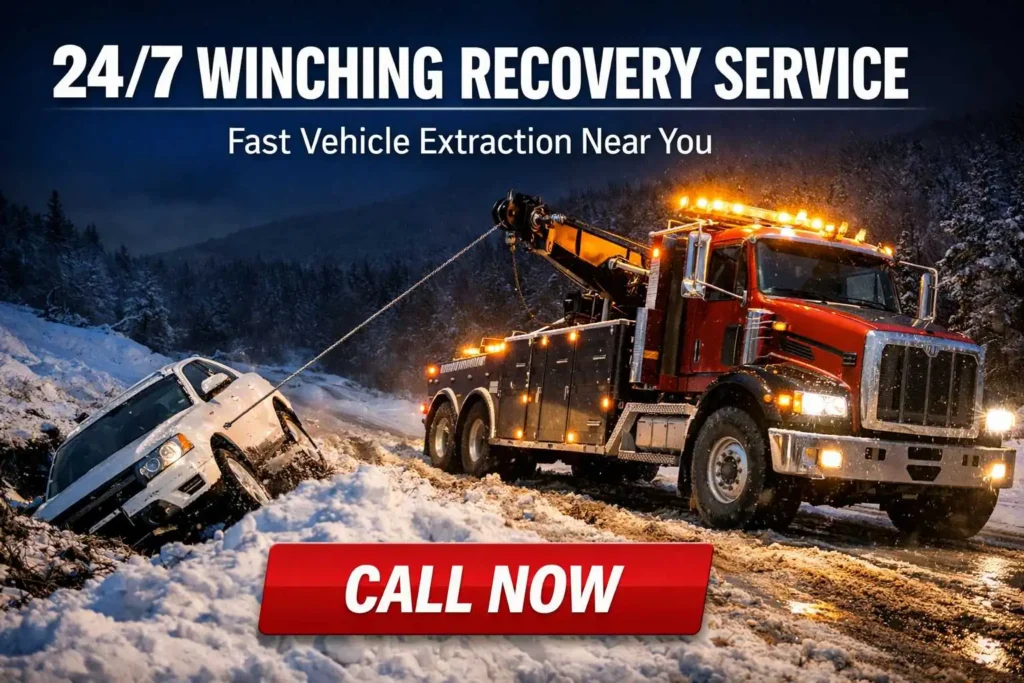
A winch out service uses a motorized cable or rope system — mounted on the tow truck — to pull a stuck vehicle out of its position and back onto a solid surface. Here’s the step-by-step process:
1. Assessment. The operator evaluates your vehicle’s position, the terrain, the angle, and any obstacles. They determine the safest direction to pull, the attachment points on your vehicle, and whether the ground conditions will support the truck’s weight and traction.
2. Truck positioning. The tow truck positions itself on firm ground with a clear line of pull to your vehicle. The truck may use outriggers (stabilizing legs) or its own brakes to anchor itself. If the ground is soft, the operator may need to reposition multiple times to find solid footing.
3. Cable attachment. A steel cable or synthetic winch rope is run from the truck’s winch drum to a rated recovery point on your vehicle — typically the frame, a factory tow hook, or a reinforced subframe point. The cable is never attached to bumpers, suspension components, or body panels, as these can tear off under load.
4. Controlled pull. The winch engages and slowly pulls the vehicle along the cable’s path. The operator controls the speed and direction, making adjustments as the vehicle moves. The driver may be asked to sit in the car and steer during the pull, or the vehicle may be pulled unoccupied depending on safety considerations.
5. Road return. Once the vehicle is back on a solid, level surface, the cable is disconnected and the operator checks for visible damage — to the vehicle, tires, and undercarriage. If the vehicle is driveable, you’re free to go. If the recovery revealed damage that makes it undriveable, a tow to a mechanic is arranged.
🚨 Safety Note: Never attempt to winch yourself out using a tow strap attached to a tree, post, or another vehicle without proper training and equipment. Tow straps under tension store enormous energy — a snap or failure sends the strap (or the attachment point) flying like a projectile. Professional winching uses rated equipment, controlled tension, and safety protocols that prevent catastrophic failures. A $100–$250 professional winch out is not worth risking a life-threatening injury to avoid.
Common Scenarios: Winch, Tow, or Both?
Here’s a quick reference for the most common stuck-vehicle situations Hamilton drivers encounter, and which service each one requires:
How Much Does Winching Cost vs. Towing?
Winching and towing are priced differently because they involve different equipment, labour intensity, and time. Here’s what each costs in the Hamilton area:
Prices are estimates for the Hamilton, Burlington, and Waterdown area. After-hours, heavy vehicles, and extreme terrain may cost more. Get a personalized estimate at the Towing Hamilton cost estimator.
For a detailed breakdown of per-kilometre towing rates and how distance affects your total bill, see our complete guide on towing costs per kilometre in Ontario.
What Affects Winching Difficulty and Cost?
Not all winch outs are equal. A car with two wheels in a shallow gravel ditch is a fundamentally different job than an SUV buried hood-deep in a muddy field. Here’s what makes a recovery more complex and more expensive:
Depth and angle. A vehicle that’s sitting at a slight angle in a shallow ditch can be pulled straight back with a single cable pull. A vehicle that’s nose-down on a steep embankment may require multiple rigging points, angle changes, and carefully staged pulls to avoid rolling or causing further damage. Deeper situations take more time and more skill.
Ground conditions. Firm ground under the tow truck makes everything easier. Soft mud, deep snow, or loose gravel can compromise the truck’s own traction — meaning the operator needs to anchor the truck differently, use outriggers, or position on a harder surface further from the stuck vehicle (requiring longer cable runs).
Vehicle weight. A 1,200 kg compact car requires significantly less pulling force than a 2,500 kg pickup truck or a 3,000+ kg SUV loaded with cargo. Heavy-duty recovery for larger vehicles uses heavier equipment and costs more.
Obstacles and access. Can the tow truck get within cable range of the stuck vehicle? Guard rails, trees, other vehicles, fences, and terrain features may block direct access, requiring the operator to run the cable around obstacles or use snatch blocks (pulleys) to redirect the pull — adding time and complexity.
Time of day and conditions. Night recoveries, heavy rain, snowstorms, and extreme cold all increase difficulty. Visibility is reduced, footing is treacherous, and the operator’s dexterity is compromised by cold. After-hours premiums (20–50%) also apply.
Whether the vehicle is running. A running vehicle can assist the recovery — the driver steers and applies gentle throttle to help the winch. A dead vehicle is dead weight that must be dragged, which requires more force, takes longer, and puts more stress on the cable and attachment points.
Stuck Right Now?
Ditch, snowbank, mud, embankment — one call gets you out. 24/7 across Hamilton.
(905) 481-0133
Can You DIY a Winch Out? When to Try vs. When to Call
Not every stuck vehicle needs a professional recovery. Some situations can be resolved yourself — and some absolutely cannot. Here’s how to tell the difference:
You CAN Probably Handle It Yourself When:
✅ Your wheels are spinning on snow or ice but the vehicle is still on relatively flat ground — spread cat litter or sand for traction, rock gently between drive and reverse. See our full guide on getting unstuck from snow.
✅ One or two wheels are slightly off the pavement edge into soft ground, but the car isn’t tilted and can be rocked out with gentle throttle and traction aids.
✅ You have a proper rated tow strap, a second vehicle with adequate weight and power, and a clear understanding of how to attach and pull safely (frame-to-frame, never bumper-to-bumper).
Call a Professional When:
🚩 The vehicle is in a ditch deeper than the wheel height — the chassis is resting on the ground and the wheels have no traction.
🚩 The vehicle is on an incline or embankment where pulling it with a strap could cause it to roll or slide sideways.
🚩 The vehicle is axle-deep in mud and has been there long enough for suction to build up — the force required to break suction can exceed what a strap-and-truck combination can safely handle.
🚩 You’re on a highway shoulder and getting out to attach a strap would put you in traffic.
🚩 The vehicle may have hidden damage — bent suspension, broken axle, or drivetrain damage from the impact of going off-road.
🚩 The ground is too soft for another vehicle to get close without also getting stuck. If the helper vehicle gets stuck, you now have two stuck vehicles — which happens more often than people admit.
What Happens to Your Vehicle After Recovery?
Once the winch has pulled your vehicle back onto solid ground, the job may or may not be finished. Here’s what to expect after recovery:
Visual inspection. The operator checks for visible damage — dented body panels, torn bumpers, broken lights, flat tires, leaking fluids, or anything hanging underneath the car. They’ll also check whether the steering, brakes, and drivetrain seem to function when the vehicle is moved.
If the vehicle is driveable: You can drive away. However, even if the car seems fine, it’s wise to have a mechanic check the alignment, suspension, and undercarriage within a few days — impacts from ditches and snowbanks can cause hidden damage that shows up later as pulling, vibration, or unusual tire wear.
If the vehicle is undriveable: The operator arranges towing to your mechanic or another destination. Since the tow truck is already on-site, the transition from recovery to towing is seamless. The vehicle is loaded onto the truck and transported. You’ll pay for both the winch out and the tow as separate line items on the invoice.
If it’s an accident: If you went off the road due to a collision (with another vehicle, an animal, or road infrastructure), document the scene, exchange information with the other driver if applicable, and contact your insurance. Read our guides on what to do after an accident and working with insurance adjusters for the full post-recovery process.
Hamilton-Specific Recovery Hotspots
Hamilton’s geography creates recurring vehicle recovery situations in specific locations. If you drive these areas regularly, you’re statistically more likely to need a winch out at some point:
Escarpment access roads. The Claremont Access, Jolley Cut, Beckett Drive, Sherman Access, and Kenilworth Access are steep and narrow. Ice, snow, and standing water make these roads treacherous in winter, and vehicles regularly slide into the rock cuts, guardrails, or ditches along these routes.
Red Hill Valley Parkway curves. The Red Hill’s curves — particularly the interchange with the Linc and the curves near the Greenhill Avenue exit — see frequent off-road incidents in wet and icy conditions. The grassy shoulders and ditches along the Parkway are common winch-out locations.
Rural roads south of the city. Concession roads through Flamborough, Ancaster, and the south mountain have narrow shoulders, steep ditches, and limited lighting. Vehicles leaving the road here often end up in deep agricultural ditches that require extended-reach winching.
Parking lots and side streets after heavy snowfall. The less dramatic but more common scenario: vehicles getting stuck in unplowed or poorly plowed parking lots, side streets, and driveways after a heavy snowfall. These are typically straightforward winch outs — short pull, firm ground nearby — and are the majority of winter recovery calls.
Construction zones. Hamilton’s ongoing LRT construction and road work creates soft shoulders, temporary gravel surfaces, and altered road layouts that catch drivers off guard. Vehicles leaving paved surfaces onto unprepared ground regularly need recovery during active construction seasons.
Does Insurance Cover Winching and Vehicle Recovery?
Coverage for vehicle recovery depends on your specific insurance policy and the circumstances of the incident:
Roadside assistance add-on: Most insurance-based roadside assistance plans include some level of winch-out or stuck-vehicle recovery. However, coverage is often limited — many plans cap winch-out coverage at a specific dollar amount ($100–$200) or limit it to “within X metres of the roadway.” Deep off-road recovery may exceed plan limits.
CAA membership: CAA covers winch-out service at all membership tiers, but with limitations. Basic tier coverage is more restricted than Plus or Premier. Complex or off-road recoveries may require additional charges beyond what the membership covers.
Collision coverage: If you went off the road due to an accident (collision with another vehicle, an animal strike, or a single-vehicle incident), the recovery costs may be covered under your collision or comprehensive coverage — separate from your roadside assistance. Contact your insurer and file a claim.
Reimbursement option: Even if your plan doesn’t dispatch a recovery-capable truck, many policies reimburse reasonable recovery costs if you pay out of pocket and submit the receipt. Keep the itemized invoice from the tow operator — it’s your documentation for reimbursement. For full details on coverage options, see our guide on whether insurance covers towing in Ontario.
How to Prevent Getting Stuck in the First Place
The cheapest winch out is the one you never need. Here are practical prevention tips for Hamilton drivers:
Install winter tires. The single biggest improvement you can make for winter traction. Winter tires reduce your chance of sliding off the road by providing dramatically better grip in cold temperatures, snow, and ice. They’re especially important on the escarpment accesses. According to Transport Canada, winter tires can reduce braking distances on ice by up to 25%.
Slow down in bad conditions. Speed is the number one factor in vehicles leaving the road. Reduce speed before curves, bridges, and overpasses — all of which ice before regular roads. On the Red Hill and the Linc, reduce speed significantly during rain, snow, and fog.
Don’t fight soft shoulders. If your tire drops off the pavement edge onto a soft shoulder, don’t jerk the steering wheel to get back on — this is how vehicles roll. Instead, slow down gradually, steer straight until you can safely re-enter the lane at low speed.
Avoid unpaved shortcuts. During spring thaw and after heavy rain, unpaved roads and laneways turn into mud traps. If you don’t have 4WD or AWD, stay on paved roads. If you must use an unpaved road, maintain steady momentum — don’t stop on soft ground.
Keep a winter driving kit in your car. Traction aids (cat litter, sand), a small shovel, and a tow strap can resolve minor stuck situations before they become expensive recovery calls.
Know your vehicle’s limits. AWD doesn’t mean invincible — it helps with acceleration but doesn’t improve braking or cornering on ice. Read our drivetrain guide to understand what your system can and can’t do in winter conditions.
What to Tell the Dispatcher When You’re Stuck
The more detail you give the dispatcher, the faster and more accurately they can respond. When you call Towing Hamilton for a winch out service, provide:
Your exact location. GPS coordinates from your phone, or the nearest intersection, highway marker, or landmark. “I’m in the ditch on Concession 6 near the Flamborough Centre Road intersection” is infinitely more useful than “I’m stuck somewhere near Flamborough.”
Your vehicle year, make, model, and drivetrain. “2021 Ford F-150 4×4” tells the dispatcher the weight class and that a flatbed may be needed if towing follows. Mentioning AWD or 4WD ensures the right equipment is sent.
How you’re stuck. “I slid into a ditch on the passenger side” vs. “I’m high-centred on a snowbank” vs. “All four wheels are buried in mud” — each scenario requires a different approach and different equipment.
Whether the vehicle still runs. This determines whether you need recovery only or recovery plus towing.
Whether there’s visible damage. Broken axle, flat tire, leaking fluid, deployed airbag — any of these affect the recovery approach and whether towing will follow.
Whether you feel safe. If you’re on a highway, in a dangerous position, or if conditions are deteriorating, say so. Safety-critical calls are prioritized.
Your Rights During Vehicle Recovery
Under Ontario’s TSSEA, the same consumer protections that apply to towing also apply to vehicle recovery:
✅ You choose who recovers your vehicle. Even if police are on scene, you select the recovery operator unless police direct an immediate removal for safety.
✅ You receive a price estimate before consenting. The operator should provide a cost estimate before beginning the winch out. Complex recoveries may be estimated as a range.
✅ You sign a consent form. Consent to Tow (or Recovery) must be documented before work begins.
✅ Charges cannot exceed published maximum rates. The operator’s filed rates with the Ontario MTO are the ceiling.
✅ You receive an itemized invoice. Winching and towing should be listed as separate line items if both services are performed.
✅ Multiple payment methods accepted. Cash, debit, credit card, or cheque — required by law. For a comprehensive guide to the protections you’re entitled to, see how to choose a towing company you can trust.
Winching & Vehicle Recovery FAQ
What is the difference between winching and towing?
Winching pulls a stuck vehicle from where it’s trapped (ditch, snow, mud, embankment) back onto a driveable surface. Towing transports a vehicle from one location to another. If your car is off the road but driveable, you need winching. If your car is on the road but won’t drive, you need towing. If it’s off the road AND undriveable, you need both — winching to recover it, then towing to transport it.
How much does a winch out cost in Hamilton?
A standard winch out in Hamilton costs $100–$250 depending on complexity. Simple recoveries (shallow ditch, snowbank) cost $100–$175. Moderate recoveries (deep ditch, mud) cost $150–$250. Complex recoveries (embankments, off-road, heavy vehicles) can exceed $250–$500+. If towing is also needed after the recovery, that’s an additional $85–$200 for a local tow. All charges must comply with the operator’s TSSEA-published maximum rates.
My car slid into a ditch — do I need a tow or a winch?
If the car is in the ditch but otherwise seems fine (engine runs, no visible damage), you likely need a winch out only — the operator pulls you back onto the road and you drive away. If the car has damage from the impact (flat tire, bent wheel, leaking fluids, undriveable), you need a winch out to recover it followed by a tow to a mechanic. When you call, describe the situation and the dispatcher will determine the right service combination.
Can I pull my car out of a ditch with a tow strap?
For minor situations where the vehicle is barely off the road on a shallow, flat surface — yes, a rated tow strap (10,000+ lb rating) attached to proper frame points on both vehicles can work. However, for deeper ditches, inclines, or mud, a tow strap is not safe — the forces involved can exceed the strap’s capacity, and a snapping strap is a lethal projectile. Never attach a strap to bumpers, tow hooks not rated for recovery, or any plastic component. When in doubt, call a professional.
Does insurance cover winch out service?
Many insurance-based roadside assistance plans include some level of stuck-vehicle recovery, though coverage limits vary. CAA also covers winch-outs at all tiers. If the stuck vehicle resulted from an accident, recovery costs may be covered under collision or comprehensive coverage separately. Even if your plan doesn’t cover the full cost, many insurers reimburse reasonable out-of-pocket recovery expenses when you submit the itemized invoice. Check your specific policy or call your insurer to confirm.
How long does a winch out take?
From the truck’s arrival, a simple winch out (shallow ditch, good access) takes 15–30 minutes. Moderate recoveries (deeper situations, repositioning required) take 30–60 minutes. Complex recoveries (embankments, off-road, multiple rigging setups) can take 1–2+ hours. Add the truck’s travel time to your location (20–45 minutes in Hamilton) for the total time from call to completion.
Will winching damage my car?
Professional winching, performed correctly with rated equipment attached to proper recovery points, should not damage your vehicle. The cable or strap is attached to reinforced frame points, not body panels or bumpers. However, the event that put you in the ditch may have already caused damage — bent suspension, wheel damage, or undercarriage scrapes — which the recovery process may reveal. A good operator photographs the vehicle before and after recovery to document its condition.
What if the tow truck can’t reach my stuck vehicle?
Professional winch trucks carry 15–30+ metres of cable, which provides significant reach beyond the truck’s parking position. If the vehicle is still beyond direct cable range, operators use extension cables, snatch blocks (pulleys that redirect the pull), or chain multiple recovery points. For extremely remote or difficult-access situations, specialized heavy recovery equipment or even a heavy-duty wrecker may be needed. Describe the situation in detail when you call so the dispatcher can send appropriate equipment.
I’m stuck in mud — will a tow truck get stuck too?
This is a legitimate concern — and experienced operators account for it. The tow truck positions itself on the firmest available ground, often on the paved road surface rather than venturing onto the soft terrain where you’re stuck. The winch cable bridges the distance between the truck on solid ground and your vehicle in the mud. If the ground near the recovery point is too soft for even the truck, the operator may need to use a longer cable run, ground anchors, or a different approach angle. The dispatcher should assess this risk when you describe the situation.
Should I stay in my car while it’s being winched?
It depends on the situation — the operator will tell you. In some recoveries, the driver is asked to sit in the car and steer during the pull to guide the vehicle back onto the road. In others — particularly steep inclines or unstable situations — the operator will ask everyone to stand well clear of the vehicle and cable path for safety. Always follow the operator’s instructions. If you’re in the vehicle, keep your seatbelt on during the pull.
Stuck? We’ll Get You Out.
Ditches, snowbanks, mud, embankments — professional recovery across Hamilton.
24 hours a day, 7 days a week — including storms and holidays.
(905) 481-0133