Towing Scams in Ontario: How to Spot and Avoid Predatory Towers
Ontario has a towing problem — and it’s not potholes or highway breakdowns. It’s predatory towing: a pattern of dishonest, aggressive, and sometimes criminal behaviour by a minority of tow truck operators who exploit drivers at their most vulnerable moments. After an accident, a breakdown, or a late-night emergency, you’re stressed, confused, and desperate to get your car handled. That’s exactly when predatory towers strike.
The problem got so severe that Ontario passed the Towing and Storage Safety and Enforcement Act (TSSEA) in 2021, creating an entirely new regulatory framework specifically to combat towing scams. The legislation introduced mandatory operator certification, published rate ceilings, consent requirements, and enforcement powers — giving consumers real tools to fight back against predatory practices.
This guide exposes the most common towing scam tactics used in Ontario, teaches you exactly how to protect yourself, explains your rights under the TSSEA, and tells you what to do if you’ve already been victimized. Knowledge is your strongest defence — and sharing this guide with friends and family protects them too. If you need a tow right now from a TSSEA-certified, transparent operator, call Towing Hamilton at (905) 481-0133.
The 10 Most Common Towing Scams in Ontario
These are the tactics that predatory towing operators use most often. Recognizing them is the first step to avoiding them:
🚩 Scam #1
The “Chaser” — Arriving Unsolicited at Accident Scenes
How it works: A tow truck arrives at the accident scene within minutes — before you’ve called anyone. The driver monitors police scanners or has arrangements with body shops and insurance adjusters to be first on scene. They pressure you to sign a consent form immediately, sometimes while you’re still in shock. Why it’s dangerous: Chasers typically charge inflated rates, tow to their preferred (kickback) body shop or storage yard, and create a billing situation that’s hard to escape. Your defence: You are never obligated to use any tow truck that arrives without you calling. Tell them: “I haven’t called for a tow yet. I’ll choose my own company.”
🚩 Scam #2
The Bait-and-Switch Quote
How it works: The operator quotes $120 on the phone. When the truck arrives, the driver says the price is actually $250 because of “special equipment needed” or “the situation is more complex than described.” The consent form has the higher number, or worse — the price field is blank. Your defence: Get the quote in writing (text or email) before the truck arrives. Never sign a consent form that doesn’t match the phone quote. If the price changes at the scene, refuse and call a different company.
🚩 Scam #3
The Unauthorized Destination
How it works: You request your vehicle be taken to your mechanic on Upper James. Instead, the tow truck takes it to a storage yard across town — one affiliated with the towing company. Now you’re paying daily storage fees while trying to get your car moved again. Why it works: Drivers who aren’t paying attention or who don’t confirm the destination on the consent form get redirected. Your defence: Confirm the destination is written on the consent form. If the driver goes somewhere else, this is a TSSEA violation — document it and report it.
🚩 Scam #4
Cash-Only Payment Demand
How it works: When you arrive at the storage yard to retrieve your vehicle, you’re told “our card machine is broken” or “we only accept cash or e-transfer.” This eliminates the paper trail and makes disputing charges nearly impossible. Your defence: Under the TSSEA, operators must accept cash, debit, credit card, and cheque. Cash-only demands are a legal violation. Note the operator’s name and TSSEA certificate number, pay if necessary to retrieve your car, and file a complaint immediately.
🚩 Scam #5
Inflated Storage Fees
How it works: Your vehicle is taken to a storage yard that charges $75–$150 per day — far above the market rate of $30–$75/day. By the time you retrieve it 5 days later, the storage bill alone is $375–$750. Some yards also charge “gate fees,” “release fees,” or “after-hours access fees” on top of daily storage. Your defence: Storage rates must be in the operator’s published rate schedule. Compare the charged rate against the published maximum. Any fee not in the schedule is unauthorized.
🚩 Scam #6
Phantom Charges on the Invoice
How it works: The invoice includes charges for services that weren’t performed: “winching fee” when no winching occurred, “fuel surcharge” on top of the per-km rate, “admin fee,” “cleanup fee,” or “dolly charge” when dollies weren’t used. Your defence: Review every line item and ask for an explanation of each charge. Compare against the consent form and published rate schedule. Any charge not disclosed before consent is unauthorized. See our complete guide to reading your towing invoice.
🚩 Scam #7
The “Blank Consent Form” Trick
How it works: The driver asks you to sign a consent form where the price, destination, or other key fields are left blank — “we’ll fill it in after.” They then fill in whatever they want. Your defence: Never sign a blank or incomplete consent form. Every required field — especially the price estimate, destination, and your vehicle information — must be filled in before you sign. If the driver pushes back, refuse and call a different company.
🚩 Scam #8
Holding Your Vehicle Hostage
How it works: You dispute the charges and the storage yard refuses to release your vehicle until you pay their inflated invoice in full. Meanwhile, storage fees continue accruing — creating pressure to pay whatever they demand to stop the bleeding. Your defence: Pay what’s required to retrieve the vehicle (fighting storage fees while the car sits there only adds cost), keep every receipt and document, and file a complaint for reimbursement after. The TSSEA gives the Director of Towing the power to investigate and order refunds.
🚩 Scam #9
The Body Shop Kickback Network
How it works: The tow driver steers you toward a specific body shop or mechanic — “I know a great place, they’ll take care of you.” The reality: the tow operator has a financial arrangement with that shop (a referral fee or percentage of the repair bill). The shop may overcharge for repairs or perform unnecessary work. Your defence: Always choose your own repair shop. The tow driver is not your advisor — their recommendation may be financially motivated.
🚩 Scam #10
The Inflated Distance Charge
How it works: Your tow was 15 km but the invoice says 28 km. The operator took a longer route — or simply inflated the distance on paper. At $4/km, those extra 13 km cost you an extra $52, which most drivers won’t bother to dispute. Your defence: Check the distance on Google Maps between your pickup and drop-off locations. If the invoice distance is significantly higher than the actual route, dispute it. See our towing cost per km guide for standard distance-based pricing.
Why the TSSEA Was Created
Ontario’s towing scam crisis reached a breaking point in the late 2010s. Violent territorial disputes between tow operators at accident scenes — including assaults, threats, and even shootings — made national headlines. Drivers reported being intimidated, overcharged, and having their vehicles held hostage. Insurance fraud involving tow operators, body shops, and health clinics was estimated to cost Ontario drivers hundreds of millions annually through inflated premiums.
The provincial government responded with the Towing and Storage Safety and Enforcement Act (TSSEA), which took effect in stages starting in 2021. The legislation established the first comprehensive regulatory framework for the towing industry in Ontario’s history — creating a Director of Towing with real enforcement powers, mandatory operator certification, published rate schedules, and clear consumer protections.
The TSSEA is your primary legal weapon against predatory towing. Understanding what it requires operators to do — and what it prohibits — puts you in a position of knowledge that predatory operators count on you not having. For a comprehensive guide to every protection the TSSEA provides, see our detailed post on your towing rights under the TSSEA.
Your TSSEA Rights: The Protections That Stop Scams
Here are the specific TSSEA consumer protections designed to prevent every scam listed above:
🛡️ You choose your tow operator. No one can force you to use a specific company — not police, not a tow truck that arrives uninvited, not an insurance company. This right directly counters the chaser scam.
🛡️ Published maximum rates. Every certified operator must file their maximum rates. No charge on your invoice can exceed these filed rates. This directly counters bait-and-switch pricing and phantom charges.
🛡️ Rate schedule disclosure. Before you consent, the operator must show you their rate schedule. You can compare the proposed charges against the published maximums in real time.
🛡️ Written consent with pricing. A signed Consent to Tow form with the agreed price and destination is required before your vehicle is moved. This directly counters blank consent forms and unauthorized destinations.
🛡️ Itemized invoices. Lump-sum billing is non-compliant. Every charge must be listed separately and explained. This makes phantom charges visible and disputable.
🛡️ Multiple payment methods. Cash, debit, credit card, and cheque must all be accepted. Cash-only demands are a violation.
🛡️ Free access to personal belongings. Storage facilities cannot hold your belongings hostage. You can access the vehicle interior to retrieve personal items at no charge.
🛡️ Director enforcement. The Director of Towing can investigate complaints, issue compliance orders, suspend or revoke certificates, and impose penalties. This gives the law real consequences for violators.
How to Protect Yourself Before You Need a Tow
The best defence against a towing scam is preparation. These steps take 5 minutes and protect you when the moment of vulnerability arrives:
Save a trusted towing company’s number now. Don’t wait until you’re standing on a highway shoulder to Google “tow truck near me” — that’s when predatory operators thrive. Add (905) 481-0133 (Towing Hamilton) to your phone contacts today. When you need a tow, you’ll call a company you’ve already researched instead of whoever shows up uninvited.
Know the fair market rate for a local tow. A standard local tow in Hamilton costs $85–$200. A flatbed costs $15–$25 more. If someone quotes $350+ for a 15 km local tow with no recovery or special circumstances, that’s above market rate. Use the Towing Hamilton cost estimator to know what’s fair before you call.
Verify TSSEA certification. Legitimate operators display their TSSEA certificate number on the truck and on invoices. An uncertified operator has no legal obligation to follow TSSEA consumer protections — and no regulatory oversight if they scam you. Learn the full vetting process in our guide on how to choose a towing company you can trust.
Know your insurance roadside coverage. If your insurance or CAA covers towing, you’ll be less pressured to accept the first truck that appears. Knowing you have coverage gives you the confidence to refuse an unsolicited tow and call your own provider. See our roadside assistance guide for what your plan actually covers.
Download or bookmark this guide. Share it with family members who drive — especially new drivers, elderly parents, and anyone who commutes on highways. Knowledge shared is protection multiplied.
What to Do at the Scene If a Tow Truck Arrives Uninvited
An unsolicited tow truck at your accident or breakdown scene is the most common starting point for a scam. Here’s exactly how to handle it:
“Thank you, but I’ll be calling my own tow company.” This single sentence is your first defence. You’re being polite but firm. You owe no explanation. The driver may push back — “I’m already here, it’ll save you time” or “police called me” — stand your ground.
Do not sign anything. The driver may present a consent form and ask you to “just sign so we can get started.” Signing gives them legal authorization to tow your vehicle. Once signed, you’ve consented — and undoing it becomes a dispute rather than a simple refusal.
If police are on scene, confirm with the officer. In rare cases, police may direct an immediate tow for safety (vehicle blocking a highway, hazardous position). In this case, the officer will explain the situation. But even then, you can request a specific company — police facilitate the tow for safety, but the choice of operator is still yours under the TSSEA unless there’s an immediate public safety need.
Note the truck’s details. If an unsolicited tow truck arrives and the driver is aggressive, pushy, or refuses to leave, note the truck number, company name, TSSEA certificate number (if displayed), driver’s appearance, and licence plate. Report the incident to the Ontario MTO — aggressive solicitation is a TSSEA violation.
Call your own tow company immediately. The sooner your chosen operator is dispatched, the less pressure the uninvited driver can apply. Call (905) 481-0133 and tell the dispatcher your location and situation — your truck is on the way.
What to Do If You’ve Already Been Scammed
If you’ve been overcharged, had your vehicle taken to an unauthorized destination, or were subjected to any of the tactics described above — here’s how to fight back:
1. Retrieve your vehicle first. Pay what’s demanded (if necessary to get the vehicle back) so storage fees stop accruing. Disputing from a position where your car is still in their yard gives them leverage — not you.
2. Document everything. Photograph the invoice, consent form, rate schedule (if provided), the tow truck (number, company name, TSSEA certificate), and any signage at the storage yard. Write down a detailed timeline of events while memory is fresh.
3. File a complaint with the Ontario MTO. Submit to the Ontario consumer complaint portal or email towing@ontario.ca. Include all documentation. The Director of Towing has the authority to investigate, issue compliance orders, suspend certifications, and require refunds.
4. Contact your insurance company. If the tow was related to an accident claim, your insurer has a vested interest in the towing charges being legitimate. They may assist in disputing inflated charges or unauthorized storage fees.
5. File a complaint with the Better Business Bureau. A BBB complaint creates a public record of the company’s predatory behaviour and may prompt a resolution.
6. Leave a factual Google review. A detailed, factual review that documents the overcharge with specific amounts and circumstances warns other drivers. Stick to verifiable facts — dates, dollar amounts, specific charges — and avoid emotional language.
7. Consider Small Claims Court. For overcharges exceeding what the MTO complaint process can recover, Ontario’s Small Claims Court handles disputes up to $35,000. With clear documentation of TSSEA violations, your case is strong. A licensed paralegal can file on your behalf.
Accident Scenes: Where Scams Are Most Common
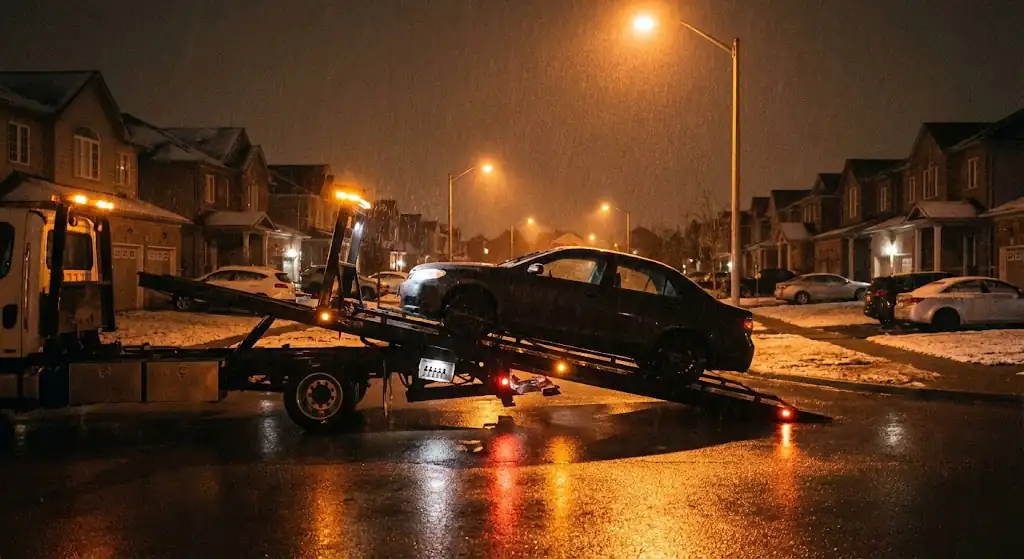
Accident scenes are the highest-risk environment for predatory towing. You’re shaken, possibly injured, and making decisions under duress. Here’s what makes accident-scene towing particularly vulnerable to abuse:
Emotional state. After a collision, your adrenaline is high, your thinking is impaired, and you’re focused on safety and insurance — not on evaluating a tow truck driver’s legitimacy. Predatory operators exploit this state to rush you through signing consent forms and agreeing to destinations.
Time pressure. Police and traffic want the scene cleared quickly. There’s pressure to “just get the car out of here.” Predatory operators use this urgency to bypass the consent process — “we need to move quickly, just sign here.”
The insurance billing trap. The victim thinks: “insurance is paying anyway, so the price doesn’t matter.” This is exactly the attitude that funds the scam economy. Inflated towing and storage charges get passed to your insurer, which eventually raises premiums for all Ontario drivers.
For a complete guide on managing the post-accident process, including choosing your own tow operator and understanding your destination rights, see our guides on what to do after a car accident and working with insurance adjusters.
Red Flags When Choosing a Towing Company
Before an emergency happens, here’s how to distinguish legitimate operators from predatory ones:
🚩 No website or online presence. Legitimate towing companies invest in a professional website with transparent pricing. Operators with no online presence are harder to research and review.
🚩 No TSSEA certificate number displayed. A certified operator displays their certificate number on the truck and provides it on invoices. If you can’t find a certificate number, they may not be certified — and therefore not bound by TSSEA consumer protections.
🚩 Won’t provide a price estimate on the phone. “It depends on the situation” is a legitimate response to complex scenarios. But refusing to give even a range for a straightforward local tow is a warning sign.
🚩 Mostly negative Google reviews. Patterns of reviews mentioning overcharging, hidden fees, rude drivers, or unauthorized destinations are strong indicators. A few negative reviews among many positives is normal. A majority of negative reviews is a clear warning.
🚩 Unrealistically low quotes. A company that quotes $40 for a tow that every other company quotes at $100+ is likely baiting you — the real charge will appear on the invoice. If the price sounds too good to be true, it probably is.
🚩 Pressure to commit immediately. “This price is only good for the next 10 minutes” or “I’ve got another call waiting, do you want the truck or not?” Legitimate operators don’t use high-pressure sales tactics on distressed drivers.
What a Legitimate Towing Company Looks Like
For contrast, here’s what the opposite of predatory towing looks like — the signs of a legitimate, professional operator:
✅ TSSEA-certified with a visible certificate number.
✅ Clear pricing on their website or available via phone before dispatch.
✅ A professional website with consistent branding and real reviews.
✅ A consent form filled out completely before you sign — with price and destination.
✅ An itemized invoice at delivery that matches the consent form.
✅ Accepts cash, debit, credit, and cheque without issue.
✅ The driver is professional, patient, and answers questions without pressure.
✅ The company serves the community long-term — with a physical presence and reputation to protect. Towing Hamilton operates as a 24/7 TSSEA-certified service across Hamilton, Burlington, Waterdown, and Grimsby — with published rates, transparent invoicing, and a local reputation built on trust.
The Insurance Scam Connection
Towing scams in Ontario don’t just hurt individual drivers — they’re part of a broader insurance fraud ecosystem that costs every Ontario driver money through higher premiums:
The tow-to-shop pipeline. A predatory tow operator takes your accident-damaged car to a body shop that pays kickbacks. The shop inflates the repair estimate. The inflated bill is sent to your insurance company. Your insurer pays the inflated bill — and passes the cost on to all policyholders through higher premiums.
Storage as profit. Some predatory operations generate more revenue from storage fees than from towing itself. A vehicle held in storage for 14 days at $75/day generates $1,050 — far more than the $200 tow fee. Delays in insurance processing, inaccessible storage yards, and limited business hours all work to extend storage durations.
Why it matters to you. Every inflated tow bill and fraudulent storage charge eventually reaches your insurance premium. Ontario already has among the highest auto insurance premiums in Canada — and towing-related fraud is a contributing factor. Choosing a legitimate, fairly-priced tow operator isn’t just protecting yourself — it’s pushing back against a system that raises costs for everyone. For details on how towing and insurance interact, see whether insurance covers towing in Ontario.
How Hamilton’s Towing Landscape Has Changed
The TSSEA has meaningfully improved the towing landscape in Ontario — and Hamilton specifically:
Fewer chasers at accident scenes. The certification requirement and enforcement powers have reduced the number of unsolicited tow trucks racing to accident scenes. The practice hasn’t been eliminated entirely, but it’s significantly less prevalent than before the TSSEA.
Greater price transparency. Published rate schedules mean drivers can verify charges against filed maximums — making it harder for operators to inflate prices without consequence.
Legitimate operators benefit. Companies that always operated honestly — like Towing Hamilton — benefit from a regulatory framework that distinguishes them from predatory operators. Certification and published rates reward the companies that were already doing the right thing.
The fight continues. The TSSEA created the framework, but enforcement depends on drivers knowing and exercising their rights. Every complaint filed, every scam documented, and every driver who chooses a legitimate operator over a chaser strengthens the system. Knowledge — like this guide — is the most powerful enforcement tool available.
Your Anti-Scam Checklist: Save This for Emergencies
Save or screenshot this checklist on your phone. When you need a tow, run through it:
☐ Did I call this company, or did they show up uninvited? (Only use a company you called.)
☐ Did they give me a price estimate before arriving?
☐ Is the TSSEA certificate number visible on the truck?
☐ Was I shown the rate schedule before signing?
☐ Is the consent form completely filled in (price + destination)?
☐ Does the price on the consent form match the phone estimate?
☐ Is the destination on the consent form where I actually want my car to go?
☐ Did I receive a copy of the signed consent form?
☐ Is the invoice itemized with every charge listed separately?
☐ Can I pay by debit, credit, or cheque (not cash-only)?
Towing Scam FAQ
What are the most common towing scams in Ontario?
The most common scams include: arriving unsolicited at accident scenes (chasing), quoting one price and billing a higher amount (bait-and-switch), demanding cash-only payment, towing to unauthorized storage yards with inflated daily fees, adding phantom charges to invoices, presenting blank consent forms for signature, holding vehicles hostage until inflated bills are paid, and steering drivers to body shops that pay kickbacks. The TSSEA was created specifically to address these practices.
What should I do if a tow truck shows up without me calling?
Tell the driver clearly: “I’ll be calling my own tow company.” Do not sign any consent form. You are under no obligation to use an unsolicited tow truck. If the driver becomes aggressive or refuses to leave, note the truck number, company name, and TSSEA certificate number, and report the incident to the Ontario MTO. Then call your own trusted operator — in Hamilton, call (905) 481-0133.
Can a tow company demand cash-only payment?
No. Under the TSSEA, tow operators must accept cash, debit, credit card, and cheque. A cash-only demand is a legal violation and is often used to eliminate the paper trail, making it harder to dispute charges. If an operator insists on cash only, pay if necessary to retrieve your vehicle, but note their name, truck number, and certificate number — then file a complaint with the Ontario MTO.
Where do I report a towing scam in Ontario?
File a complaint with the Ontario Ministry of Transportation through the consumer complaint portal at ontario.ca or email towing@ontario.ca. Include all documentation — invoice, consent form, photos, timeline, and the operator’s TSSEA certificate number. The Director of Towing can investigate, issue compliance orders, suspend certifications, and require refunds. For larger amounts, Ontario’s Small Claims Court handles disputes up to $35,000.
Can a tow company hold my vehicle until I pay?
A storage facility can require payment of legitimate charges before releasing a vehicle. However, they cannot deny you access to your personal belongings inside the vehicle — that access must be provided for free during reasonable business hours, regardless of whether you’ve paid. If you believe the charges are inflated, the practical advice is to pay (to stop storage fees from accruing), retrieve the vehicle, and then dispute the charges through the MTO complaint process or Small Claims Court.
What is the TSSEA and how does it protect me?
The Towing and Storage Safety and Enforcement Act is Ontario’s regulatory framework for the towing industry, enacted to combat predatory practices. It requires operator certification, published maximum rate schedules, written consent before towing, itemized invoices, multiple payment methods, and gives the Director of Towing enforcement powers including investigation, compliance orders, and certificate suspension. For a complete guide, see your towing rights under the TSSEA.
How do I know if a tow truck operator is legitimate?
Look for a visible TSSEA certificate number on the truck. Ask for their published rate schedule before signing. Check for a professional website with transparent pricing, consistent branding, and genuine reviews. A legitimate operator provides a price estimate on the phone, fills out the consent form completely before requesting your signature, and accepts multiple payment methods without pushback. For the full vetting checklist, see how to choose a towing company.
Should I sign a blank consent form?
Absolutely not. Never sign a consent form where the price, destination, or other key fields are blank. A blank consent form gives the operator legal authorization to fill in whatever they want — and your signature makes it look like you agreed. Every required field must be complete before you sign. If a driver pushes you to sign an incomplete form, refuse and call a different company.
Can police force me to use a specific tow company?
In most cases, no. Under the TSSEA, you have the right to choose your own towing provider — even at an accident scene with police present. The only exception is if police determine there’s an immediate public safety need (vehicle blocking an active highway lane, hazardous materials) that requires immediate removal before you can arrange your own operator. Even in these situations, police facilitate the tow for safety — they don’t get to choose the operator’s rates or destination.
What’s the biggest sign that a towing company is a scam?
Arriving at an accident scene without being called is the single biggest indicator of a predatory operator. Legitimate towing companies respond to calls from drivers, insurance companies, or police dispatch — they don’t monitor police scanners and race to accident scenes. If a tow truck arrives before you’ve called anyone, treat it as a red flag and decline their service regardless of what they say. Other major warning signs: no visible TSSEA certificate, cash-only demands, refusal to show a rate schedule, and pressure to sign quickly.