
How to Jump Start a Dead Car Battery (Step-by-Step Guide)
⚡ Quick Answer
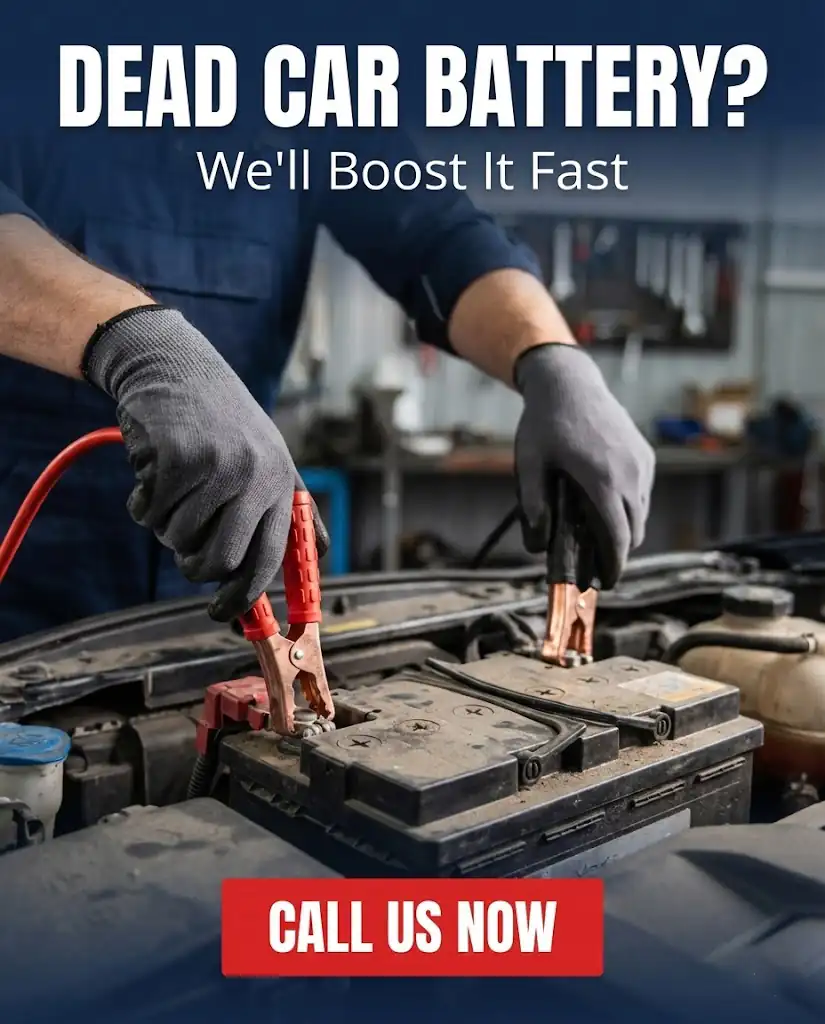
To jump start a dead car battery, connect the red (positive) cable to the dead battery’s + terminal, then to the good battery’s + terminal. Connect the black (negative) cable to the good battery’s − terminal, then clamp the other end to an unpainted metal surface on the dead car’s engine block — never directly to the dead battery. Start the working car, wait 2–3 minutes, then start the dead car. If you don’t have cables or a second vehicle, a professional battery boost in Hamilton costs $75–$125 and help typically arrives within 30 minutes.
A dead car battery is the single most common reason vehicles won’t start — and in Hamilton, Ontario, cold winter mornings make the problem significantly worse. If you’ve turned the key (or pressed the start button) and heard nothing but clicking, a weak groan, or complete silence, you’re almost certainly dealing with a battery that needs a jump start.
The good news is that a car jump start is something many drivers can do themselves — when they know the correct procedure and have the right equipment. The bad news is that doing it wrong can fry your car’s electronics, cause a battery explosion, or damage both vehicles. Modern vehicles with sensitive computer systems demand extra care.
This guide walks you through how to safely jump start a dead car battery yourself, when to skip the DIY and call for a professional battery boost service in Hamilton, and what to do if a jump start doesn’t fix the problem.
How to Know If Your Car Battery Is Dead
Before you grab the jumper cables, confirm that the battery is actually the problem. A dead battery has very specific symptoms that are different from other issues like a bad starter or alternator failure:
Signs of a Dead Battery
⚡ Rapid clicking when you turn the key — The starter solenoid is engaging but there isn’t enough power to turn the engine over.
⚡ Slow, laboured cranking — The engine turns over sluggishly like it’s struggling through molasses, then stops.
⚡ Dashboard lights flicker or dim when you try to start — Power is draining from the battery faster than it can supply.
⚡ Complete silence when you turn the key — No lights, no clicking, nothing. The battery is completely drained.
⚡ Interior lights work but the engine won’t crank — The battery has some charge but not enough to engage the starter motor.
⚡ Battery warning light on the dashboard — This can indicate a dying battery, failing alternator, or loose connections.
If you recognize any of these symptoms, a jump start is likely the fastest fix to get you moving. For a deeper dive into battery health, check out our guide on the 5 warning signs your car battery is about to die.
What You Need to Jump Start a Car
Before attempting a battery jump start, make sure you have the right equipment. There are two methods — using a second vehicle with jumper cables, or using a portable jump starter pack.
Jumper Cables + Second Vehicle
Standard booster cables (minimum 4-gauge, 12–20 feet long) connected between your dead battery and a working vehicle’s battery. Requires a willing second driver.
Cable Cost: $25–$60 at most auto parts stores
Portable Jump Starter Pack
A rechargeable lithium-ion battery pack that fits in your glove box. No second vehicle needed. Most modern units include built-in safety features like reverse-polarity protection and spark-proof clamps.
Pack Cost: $60–$150 for a quality unit
💡 Pro Tip: If you live in Hamilton and deal with cold winters, a portable jump starter is one of the best investments you can make. Modern lithium units can start a car in -30°C weather, hold a charge for months, and double as a USB power bank for your phone. Keep one in your car year-round.
How to Jump Start a Car Battery with Jumper Cables (Step-by-Step)
This is the standard method using booster cables and a second running vehicle. Follow these steps exactly in order — getting the sequence wrong can cause sparks, electrical damage, or battery explosion.
Position Both Vehicles Close Together
Park the working vehicle facing the dead vehicle so the batteries are within reach of the cables — usually nose-to-nose. Keep a gap of about 45 cm (18 inches) between the cars. Both vehicles should be in park with engines off and keys removed.
Identify the Battery Terminals
Every battery has two terminals: positive (+) marked with a plus sign and usually a red cap or cable, and negative (−) marked with a minus sign and usually a black cap or cable. If the terminals are corroded (white or greenish crust), brush them clean with a wire brush or cloth before connecting cables.
Connect the RED (Positive) Cable First
Clamp one red cable end to the dead battery’s positive (+) terminal. Then clamp the other red cable end to the good battery’s positive (+) terminal. Red to dead positive first, then red to good positive.
Connect the BLACK (Negative) Cable to the Good Battery
Clamp one black cable end to the good battery’s negative (−) terminal.
⚠️ CRITICAL — Ground the Black Cable on the Dead Car
Clamp the remaining black cable end to an unpainted metal surface on the dead car’s engine block — such as an engine bolt, bracket, or strut tower. Do NOT connect it to the dead battery’s negative terminal. This is the most important safety step in the entire process. Connecting directly to a dead battery can cause hydrogen gas sparks, which can ignite and cause the battery to explode.
Start the Working Vehicle
Start the good car’s engine and let it idle for 2–3 minutes. Some guides suggest revving gently to around 2,000–2,500 RPM to push more charge through the cables, especially in cold weather.
Attempt to Start the Dead Vehicle
Turn the key or press the start button on the dead vehicle. If it cranks but doesn’t start, wait another 3–5 minutes with the good car running and try again. If it still won’t start after 3–4 attempts, the battery may be too far gone or the problem is something other than the battery.
Remove the Cables in Reverse Order
Once the dead car is running, disconnect the cables in the exact reverse order: black ground clamp from the previously dead car first, then black from the good battery, then red from the good battery, then red from the formerly dead battery. Keep clamps from touching each other or any metal during removal.
Drive for at Least 20–30 Minutes
After a successful jump start, your alternator needs time to recharge the battery. Drive for at least 20–30 minutes (highway driving is best) before shutting the engine off. If you turn it off too soon, the battery may not have enough charge to restart.
The Cable Connection Order (Quick Reference)
Getting the order right is critical for safety. Bookmark this quick-reference chart:
Disconnect in reverse: Black ground → Black negative → Red good → Red dead.
⚠️ Warning: Reversing the polarity (connecting positive to negative) can destroy your car’s ECU, alternator, fuses, and wiring harness. The repair bill for a fried ECU alone can exceed $1,000–$3,000. If you’re unsure about any step, call for a professional battery boost — it’s far cheaper than electrical repairs.
How to Use a Portable Jump Starter Pack
Portable jump starters have become the preferred choice for many Hamilton drivers because they don’t require a second vehicle, are safer with built-in protections, and work even in parking garages or isolated locations. Here’s how to use one:
Step 1: Ensure the jump starter is charged (most units hold a charge for 3–6 months when stored properly).
Step 2: Connect the red clamp to the battery’s positive (+) terminal.
Step 3: Connect the black clamp to an unpainted metal surface on the engine block (same grounding principle as cables).
Step 4: Turn on the jump starter pack.
Step 5: Start the vehicle. Most engines fire up within seconds.
Step 6: Once the car starts, disconnect the black clamp first, then the red clamp. Drive for 20+ minutes to let the alternator recharge the battery.
Quality portable jump starters include reverse-polarity protection (they won’t activate if connected backwards), spark-proof clamps, and low-voltage detection — features that make them substantially safer than traditional jumper cables for the average driver.
When You Should NOT Jump Start a Car Battery
A jump start is a safe and effective solution in most cases — but there are situations where attempting one can make things worse or create serious hazards:
✖ The battery is cracked, leaking, or swollen — A damaged battery can release hydrogen gas and sulphuric acid. Do not touch it. Call for emergency towing and have the vehicle taken to a mechanic.
✖ You smell rotten eggs near the battery — This is hydrogen sulfide gas from a failing battery. Extremely flammable. Do not attempt a jump start.
✖ The battery is frozen — In extreme Hamilton winter cold, a fully discharged battery can freeze solid. Attempting to jump start a frozen battery risks explosion. Look through the casing — if the acid looks slushy or icy, do not attempt it.
✖ The battery has been jump started multiple times recently — If the battery keeps dying within hours or days of being jumped, it’s beyond saving. It needs replacement, not another jump start.
✖ You don’t know which terminals are positive and negative — Guessing can destroy your car’s electronics. When in doubt, call a professional.
✖ The donor vehicle has a different voltage system — Most passenger vehicles are 12V. Never use a 24V truck or heavy equipment battery to jump a 12V car.
Dead Battery? We’ll Get You Started.
Professional battery boost in Hamilton, Burlington, Waterdown & Grimsby — 24/7/365.
(905) 481-0133
How Much Does a Professional Battery Boost Cost in Hamilton?
If you don’t have cables, a jump starter, or a willing neighbour — or you’d simply prefer a professional handle it — here’s what to expect for pricing in the Hamilton area:
Prices are estimates for the Hamilton, Burlington, Waterdown, and Grimsby area. Get a personalized quote with our online towing cost estimator.
Many Ontario auto insurance policies include roadside assistance that covers battery boosts. Before paying out of pocket, check if your policy covers it — our guide on whether car insurance covers towing in Ontario explains what to look for.
Why Car Batteries Die Faster in Hamilton Winters
Cold weather is the number-one killer of car batteries, and Hamilton’s climate — with overnight lows regularly hitting -15°C to -25°C between December and February — puts enormous strain on every battery in the city. Here’s the science behind it:
Chemical reactions slow down in the cold. A car battery generates electricity through a chemical reaction between lead plates and sulphuric acid. At -18°C, a fully charged battery only delivers about 65% of its normal cranking power — while the engine requires roughly twice as much power to start in cold, thickened oil.
Short trips prevent full recharging. Hamilton drivers who make short commutes (under 15 minutes) never give the alternator enough time to fully recharge the battery. Each start draws more power than the alternator can replace, slowly draining the battery over days.
Heated seats, defrosters, and lights add load. Every winter accessory you run — heated seats, rear defroster, headlights, heated steering wheel — draws power from the alternator, leaving less for battery charging.
Age compounds the problem. A 3-year-old battery that performs fine in summer may fail completely on the first -20°C morning. Most batteries last 3–5 years in Ontario’s climate. If yours is approaching that range, proactive replacement before winter is far less stressful than an emergency jump start on a freezing Monday morning.
Jump Start Didn’t Work? What to Do Next
If you’ve followed the jump start process correctly and the car still won’t start, the problem may not be the battery. Here are the most likely culprits:
Bad starter motor — If you hear a single loud click (not rapid clicking) when turning the key, the starter solenoid or motor may have failed. A jump start can’t fix this.
Failed alternator — If the car starts after a jump but dies again within minutes, the alternator isn’t charging the battery. The car will need to be towed to a mechanic.
Corroded or loose battery terminals — Even with a good battery, loose or corroded connections can prevent current from flowing. Clean the terminals and tighten the clamps.
Blown fuse or relay — Certain fuses protect the starter circuit. A blown fuse will prevent the car from starting even with a fully charged battery.
Fuel delivery issue — If the engine cranks normally but won’t fire, the problem may be fuel-related (empty tank, failed fuel pump, clogged filter). Check your fuel gauge first, and if you’re simply out of gas, emergency fuel delivery can get you going without a tow.
When a jump start fails, breakdown towing to your preferred mechanic is the next step. Towing Hamilton can attempt a battery boost on-site and, if the vehicle still won’t start, tow it directly to a repair shop in a single service call — no need to book two separate trucks.
Can You Jump Start a Hybrid or Electric Vehicle?
This is one of the most-asked questions from Hamilton drivers, and the answer depends on the vehicle type:
Hybrid Vehicles (Toyota Prius, Honda CR-V Hybrid, Ford Escape Hybrid, etc.)
Yes — hybrids have a separate 12V auxiliary battery that powers the ignition system, lights, and onboard computer. When this 12V battery dies, the car won’t start even though the main hybrid battery pack may be fully charged. You can jump start the 12V battery using the same cable process described above. However, never use a hybrid vehicle as the donor car to jump another vehicle — their 12V systems aren’t designed to handle the current draw and you can damage the hybrid’s sensitive electronics.
Fully Electric Vehicles (Tesla, Chevy Bolt, Hyundai Ioniq 5, etc.)
EVs also have a 12V battery for auxiliary systems — and it can die just like any other car battery. Boosting the 12V battery is possible, but the location and access vary significantly by manufacturer. Some EVs require opening a specific fuse box cover to reach the boost terminals. Consult your owner’s manual or call a professional who understands EV systems. If the main high-voltage battery is depleted, a jump start won’t help — you’ll need a flatbed tow to a charging station or dealer.
💡 Pro Tip: Towing Hamilton’s battery boost service team carries professional-grade power packs with built-in surge protection specifically designed for modern vehicles — including hybrids, EVs, and luxury cars with sensitive electronics. This eliminates the risk of voltage spikes that can occur with traditional cable-to-cable jumps.
Common Jump Start Mistakes That Damage Your Car
Even experienced drivers make these errors. Avoid them to protect both vehicles:
❌ Connecting black cable to dead battery negative terminal — This is the most dangerous mistake. It can cause sparks near the hydrogen gas that leaking batteries emit, potentially causing an explosion.
❌ Reversing positive and negative cables — This can instantly fry the car’s main computer (ECU), alternator diodes, and multiple fuse-protected circuits. The repair bill routinely exceeds $2,000.
❌ Using thin, cheap jumper cables — Budget cables with thin wire (10-gauge or higher) can overheat, melt their insulation, and fail to deliver enough current. Use a minimum 4-gauge or 6-gauge cable rated for your climate.
❌ Leaving electronics on during the jump — Turn off headlights, radio, heated seats, and climate control in both vehicles before connecting cables. The initial surge can damage sensitive electronics.
❌ Cranking the dead car for too long — Limit start attempts to 5 seconds with 2-minute breaks between. Extended cranking overheats the starter motor and drains the donor battery.
❌ Shutting off the car immediately after starting — Drive for at least 20–30 minutes. Shutting off the engine too soon means the battery hasn’t recharged enough to start again on its own.
How to Prevent a Dead Battery in Hamilton’s Climate
Prevention is always cheaper than an emergency boost at 6 AM in January. Here are proven strategies for Hamilton drivers:
Get your battery tested before winter — Most auto parts stores and mechanics in Hamilton will test your battery for free. A battery reading below 12.4V when the engine is off is already weakening.
Replace batteries proactively at 3–4 years — Don’t wait for failure. Ontario winters accelerate battery degradation significantly compared to milder climates.
Use a battery tender or trickle charger — If your car sits for extended periods (weekends, vacations, work-from-home days), a trickle charger maintains the battery at full charge and extends its life.
Keep terminals clean and tight — Corrosion creates resistance and reduces charging efficiency. A wire brush and some baking soda paste cleans terminals in minutes.
Minimize electrical draw when parked — Don’t leave interior lights, USB chargers, or dash cams running when the engine is off. These small draws add up overnight.
Use a block heater — Plugging in your block heater overnight reduces the strain on your battery by keeping the engine warm enough to start more easily. According to Natural Resources Canada, a block heater can reduce fuel consumption and engine wear during winter starts.
Take longer drives occasionally — If your daily commute is under 15 minutes, take a 30+ minute highway drive weekly to let the alternator fully recharge the battery.
Car Battery Jump Start FAQ
Can jump starting a car damage the battery or electronics?
If done correctly, a jump start is safe for both vehicles. The risk comes from incorrect cable connections — reversing polarity or connecting the ground clamp to the dead battery’s negative terminal instead of the engine block. These errors can cause voltage spikes that damage the ECU, alternator, and other electronics. Professional battery boost services use regulated power packs that eliminate this risk entirely.
How long does it take to jump start a dead car battery?
Once the cables are properly connected, most cars start within 2–5 minutes. In very cold weather with a severely drained battery, you may need to let the donor car run for 5–10 minutes before attempting to start the dead vehicle. The entire process from setup to driving takes about 10–15 minutes.
Why do you connect the black cable to the engine block instead of the dead battery?
Dead batteries can emit hydrogen gas, which is extremely flammable. Connecting the ground clamp directly to the battery terminal can create a spark at the battery — potentially igniting that gas and causing the battery to explode. Grounding to the engine block moves the spark away from the battery, making the jump start much safer.
How much does a battery boost cost in Hamilton?
A professional battery boost in Hamilton typically costs $75–$125, with after-hours and weekend calls at the higher end. If the battery won’t hold a charge and the vehicle needs towing, expect $100–$200 total. Many drivers find this more convenient and safer than asking a stranger for a jump in a parking lot or roadside.
How long should I drive after a jump start to recharge the battery?
Drive for at least 20–30 minutes after a successful jump start — highway driving is ideal because higher RPMs charge the battery faster. Idling alone isn’t enough. If you shut the engine off too soon, the battery likely won’t have enough charge to restart on its own.
Can I jump start my car in the rain or snow?
Yes, jump starting in rain or snow is generally safe because the voltage involved (12V) is too low to conduct through water in a dangerous way. However, avoid standing in puddles, keep connections dry where possible, and ensure the clamps have a solid grip on clean terminals. If conditions make you uncomfortable, calling for a professional roadside assistance service is the safer choice.
My car battery keeps dying after jump starting. What’s wrong?
If your battery dies within hours or days after a jump start, the most common causes are a failing alternator that isn’t recharging the battery, a parasitic electrical draw draining the battery while parked, or a battery that’s too old or damaged to hold a charge. Have a mechanic test the alternator output and check for parasitic draws. If the battery itself tests bad, replacement is the only real fix.
What gauge jumper cables should I buy?
For most passenger vehicles, 4-gauge or 6-gauge cables at least 16 feet (5 metres) long are ideal. Lower gauge numbers mean thicker wire, which carries more current. Avoid anything 10-gauge or thinner — they can overheat and may not deliver enough current to start larger engines, especially in cold weather.
Can you jump start a car with a push-button start (no key ignition)?
Yes, the jump start process is identical for push-button start vehicles. The battery, terminals, and electrical system work the same way. The only difference is that you press the start button with your foot on the brake instead of turning a key. If the key fob battery is also dead, hold the fob directly against the start button — most vehicles have an embedded NFC reader that can detect a dead fob at close range.
Is it better to jump start my car or call a professional battery boost service?
If you have quality cables or a portable jump starter, know the correct procedure, and are in a safe location, a DIY jump start is perfectly fine. Call a professional when you don’t have equipment, the battery looks damaged or swollen, you drive a hybrid or EV and are unsure about the process, or you’re in an unsafe location like a highway shoulder. A professional battery boost service uses industrial-grade equipment with built-in safety features that protect your vehicle’s electronics — and they can also test whether the battery needs replacement or if the alternator is the real problem.
Battery Dead? We’ll Bring It Back to Life.
Professional jump start service across Hamilton, Burlington, Waterdown & Grimsby.
Fast arrival — 24 hours a day, 7 days a week, including holidays.
(905) 481-0133